Version 1.1 · 18 October 2026

We originate requests for a quote, a demo or a call. From the decision-makers who sign.

For B2B sellers whose customers are worth $5,000 or more. We find the companies in your market that could buy, email the one person at each who decides, and pass you every reply that asks for a quote, a demo, a proposal, a scope call, a meeting or a call. Domains, inboxes, lists, copy and reply screening are all handled by us. This page covers what you get, what it costs, how a campaign gets built, and the system and emails behind it.

Read the full thesis doc
A meeting-ready lead: a decision-maker who replied and wants to talk, handed over with the full thread.
Travis, founder.
A flat monthly fee, $2,000 to $5,000 per month, set by how many companies we email each month and how many sending inboxes that takes. Month to month, no minimum term, no setup fee.
  • We build and run the whole cold email operation for you — domains, inboxes, lists, copy, and the screening of every reply.
  • What you get is a meeting-ready lead: a decision-maker who replied and wants to talk, handed over with the full thread.
  • What the agreement commits to is coverage: 5,000 owners from your list contacted a month, with a count you can check every month.
  • Everything behind that is done by us, and none of it comes back to your desk as a task.
  • One flat monthly fee covers all of it, and every meeting-ready lead is included. It doesn't move with volume.
  • What it changes: next quarter's pipeline stops depending on who happens to refer you, so you can forecast it and hire ahead of it.

What the guarantee is: a remedy, not a forecast. The threshold is the point below which we work at our own cost and then refund the month. It is not a prediction of what your market will return, and we make none. The free preview and the sizing call are how you judge the fit.

We want clients who let us run the outbound side

Outbound is the only thing we do. Every campaign runs on the process further down this page: how we pick the companies, check every company and every email address, write and test the copy, and screen each reply before it reaches you. It took a long time to build, and every client gets all of it.

We want to work with owners who are serious about adding customers and who trust us with the outbound side. You know your service, your team and your pricing. We know how to get a decision maker to write back. It works when each side runs its own part and tells the other what it's seeing.

The first weeks are mostly setup: domains, warmup, the list and the copy. It gets better after that, as we learn which companies answer and which emails land in your market. There is no minimum term, but a channel like this is judged on months two and three, so plan on that.

We don't work on pay per closed deal

Some owners ask if we'll skip the fee and take a cut of each deal they close. We won't, for any client, at any deal size. When someone asks, it usually tells us we'd be a bad fit.

The close happens after our part is done. We find the buyer and get them to agree to a meeting. From there the deal rides on your price, your follow-up and how you run the call. We can't see any of it and we can't change any of it. Paying us per close means paying us for your own sales skills.

Try making the same offer to anyone else. Ask Google to hold its fee until a click turns into a signed contract. Ask a salesperson to work three months unpaid and collect only on what closes. Ask a trade show to refund your booth if nobody buys. Every one of them says no, because every one of them knows the close depends on you.

The agencies that do say yes have found a way around it. They either take a cut big enough to cover every deal you don't close, or they quietly stop sending leads the month the math turns against them. Pay per close never makes marketing free. It moves the price somewhere you can't see it until later.

It would also make us the bank for your sales cycle. Plenty of B2B deals take months to sign. We'd pay for the domains, inboxes and data the whole time, then argue at the end over which deals came from us.

Every way of finding customers costs money before it pays back, so we ask clients to budget for that. Asking us to carry all of the risk while you keep all of the upside is not a basis we can work on.

If pay per closed deal is the only way you would work with us, we are not the right fit, and it is better to know that now.

What you can hold me to, in writing.

Owners tell me the same story on calls: they paid for names that never asked to hear from anyone, and got billed for every one. Every line below is in the agreement you'd sign.

Counts, all of these

  • Every reply that asks for a quote, a proposal, a demo, a meeting or a call
  • Every reply that asks a real question about what you sell
  • Each one with the whole thread, the company, the person and their title

Never counts

  • Out-of-office replies, opt-outs and bounces. I handle those
  • Your customers, partners, open quotes and anyone else on your leave-alone list. They're never emailed
What the fee buys
5,000 owners from your list contacted a month, and a count you can check every month: contacted that month, contacted to date, left to contact, and removed and why.
You read their reply the same day
A reply reaches you on the business day it arrives, or the next one if it comes in after 5pm Eastern, so you read what they actually wrote while it's fresh.
One flat fee
The fee is the same however many replies come in, so there's no count for me to pad and nothing to argue over on an invoice.
Triple Guarantee
Triple Guarantee: fewer than 5 meeting requests by day 90 and three fixes run on their own, at no extra cost: more volume, a second list, then a full reset. Still under 5 after that, and that month's fee comes back. A meeting request is a reply that asks for a quote, a demo, a proposal, a scope call, a meeting or a call. The fixes, one month each: 2,500 more new companies on top of your plan; then a second list in a new segment, region or role, with up to 2,500 more; then a full reset of the angle, the emails and the targeting, contacting 10,000 that month, all of them new (or your plan plus 2,500 if that's more). If you still have fewer than 5 after the reset, that month's fee comes back to your card within 15 business days. Each fix runs for one month, in order, and only while the total is still under 5. You don't ask for any of it, the refund included, and there's nothing to claim or choose. It holds while you approve each draft within 2 business days, answer every reply within 1 business day, send the leave-alone list within 5 business days of signing, keep the offer, its price and the target market as agreed, pay on time, and do the rest of your part under §5. Days paused on your side don't count. It runs once per agreement. Step 4 is its one refund; otherwise no credit, no change to the fee, and the term doesn't extend. It's §8 of the agreement, where it's called the Triple Commitment.
Start Commitment
Start Commitment: if sending hasn't started 21 days after you sign because of us, your first month's fee comes back. It comes back to your card within 15 business days, without you asking, and the agreement carries on unless you cancel. Delays on your side, like a late onboarding call or form or emails you haven't approved yet, don't count toward the 21 days.
You approve before anything sends
You approve in writing what the emails say about what you sell, and you give me a leave-alone list. Add to it by email any time and it takes effect within one business day.
If it isn't working, you leave
Month to month, no minimum term. Cancel by email at least 30 days before the next billing date.

Is this for you? Check before the call

If any of these describe you, we may not be a fit yet:

  • You sell to consumers
  • Deals under $5,000
  • No clear ideal customer yet — we'd be guessing, and you'd be paying for it
  • Nobody free to follow up — leads go cold fast
  • You need results inside thirty days
  • Spending a few hundred to a few thousand dollars a month on getting customers would strain the business
  • You've been in business for less than two years
  • Nobody on your side can call or email a new lead back within 24 hours
  • You couldn't take on more customers next month if they showed up
  • You need a guarantee of closed deals. Nobody can promise that honestly, because the close is yours
  • You expect to judge it on the first month. Any channel takes two or three months to judge fairly

If one of those is you, it is better to know before the call. Come back when it isn’t, and we’ll be glad to talk.

What we'll need from you.

Leads go cold when nobody works them. Before we start, you agree to this:

  • Call or email every lead back within 24 hours.
  • Tell us which leads turned into customers, so we know what to send more of.
  • Join a 20-minute review with us once a month.
  • Bring the owner, or whoever signs, to the first call.

If that is more than you can commit to, say so before the call.

How to get decision-makers in your market asking you for next steps, with sending from week three, for one flat monthly fee, using the Acceptance Gate System

The long version of this page: the evidence, the whole system step by step, and the math behind it.

Read the thesis doc

We run your cold email, done for you.

You don't get a tool, a login, or a playbook to run yourself. We build and operate the whole outbound machine: your ideal customer mapped down to the job titles that actually decide this — and the ones we're never to contact — dedicated sending domains and inboxes bought and warmed, lists built and verified, copy written and tested as replies come in, and every reply screened against your criteria before it goes anywhere.

Done for you means done for you. Two things sit on your side and nothing else: the onboarding call and the short form that goes with it — who you sell to, who to leave alone, what you sell, what we shouldn't say — and approving the copy once before anything sends. About an hour in total. We buy the domains, warm the inboxes, build and verify the lists, write and rewrite the emails, send them, screen every reply, answer the questions, sort the noise out and work the junior replies up to the person who can sign. You don't manage us and you don't manage the machine. The next time it needs you, a decision-maker is waiting on your answer.

Your own domain never touches cold outbound. We send from separate domains we build and warm for the purpose, so your reputation is never the thing at risk — that part isn't a preference, it's the difference between this working and your email landing in spam permanently.

What reaches you is a meeting-ready lead: a decision-maker who matches your ideal customer profile — right company, right role, right seniority, judged against the criteria you set rather than against whoever in the building happened to open the email — and who has replied asking for next steps, with the whole thread attached so you pick the conversation up warm rather than starting it cold. Every reply that asks for a quote, a meeting or a call reaches you the business day it lands, marked against your profile. If you'd like, we help get the call on your calendar by offering times in the thread.

When somebody junior replies instead — and they do, because they're often the person told to go and look into it — that's a redirect, not a result. A person reads it, and we work the thread to the name they give us. What lands in your inbox is the one who can sign it off.

You pay one flat monthly fee for all of it, and every meeting-ready lead the machine produces is included. Every part of getting there is ours to carry: the sending, the domains, the lists, the copy rewritten as replies come in, the emails nobody answers, the replies that turn out to be nothing. None of it appears on your invoice as a line item. Your profile goes into the onboarding form the list is built from, and your exclusions go on the leave-alone list in your agreement, so nobody on it is ever emailed.

How it runs, start to finish.

You

You write the bar

Who you want, and who to leave alone

Business listings

Google Maps

B2B database

Apollo

Buying signals

AI reads every company's website

Any that don't fit your bar are dropped here

TinyFishClaude

The decision maker

ApolloMoltSets

Their work email

MoltSetsBlitz

Verified and scrubbed

Bad emails and do-not-contact companies removed

MailTester Ninja

Separate domains

Two-week warmup

Smartlead

Copy for each company

Claude
You

You approve the copy

Nothing sends without it

Emails go out

From our inboxes

Smartlead

Every reply in one inbox

Smartlead

AI checks it against your bar

Out-of-office, opt-outs and bounces stop here

Clears your bar

A person checks it

You

The lead lands in your portal

With the thread, their title, and why it cleared

You

A miss gets one line

The targeting is tightened from the next send

What we'd send, and who gets it.

These are the angles we'd open with for a company that sells a service to other businesses. Each email goes to the person who decides at one company, from our inboxes, with your company's name on it. The examples use a made-up managed IT firm, Lakeshore IT. Yours get written from your own customers and your own service, and nothing sends until you approve it.

  1. A new administrator at the office

    An office or practice administrator in their first months is still deciding which vendors to keep. They haven't heard from everyone in town yet, and a short call is an easy yes while they're learning how the office runs.

    Where the data comes from: Apollo records when each person started in their role. We pull administrators and office managers at companies in your area who started in the last six months.

    To: Office manager, 40-person accounting firm

    Subject: IT at Brandt and Cole

    Hi Megan,

    Saw you took over as office manager at Brandt and Cole this summer.

    When you get to IT, we'd like a shot at it. We look after accounting and law offices around Milwaukee.

    Worth a short call?

    Dave, Lakeshore IT

  2. They're hiring the job you do

    A company posting a job for in-house IT help is already paying to solve the problem. Offering to cover it without the hire gets answered by the ones who haven't filled the seat yet.

    Where the data comes from: Job posts from companies in your area, the hiring signal on the flowchart above, matched to the person who runs the office from Apollo.

    To: Firm administrator, 30-person law firm

    Subject: IT coordinator role at Harbor Point

    Hi Renee,

    Saw Harbor Point Law is hiring an IT coordinator.

    We run IT for law firms around Milwaukee, so you'd have a whole team on it instead of one person, and nobody to cover for when they're out.

    Open to a call this week?

    Dave, Lakeshore IT

  3. You already work nearby

    A buyer trusts a vendor already working for a company like theirs down the street. When one of your customers is close to a company we're writing to, the email says so.

    Where the data comes from: Your current customers, from the onboarding form, matched against every target company near them from map listings.

    To: Practice manager, 25-person dental group

    Subject: Lakeview Dental

    Hi Tina,

    We look after two offices on Prospect Avenue, a few blocks from Lakeview Dental.

    Our techs are already in your neighborhood most days. Open to a short call about how you handle IT now?

    Dave, Lakeshore IT

We run two or three angles at once, split evenly across the same list, and move the volume to whichever gets more decision makers asking for a call. The copy is rewritten from what decision makers actually said back, and we tell you which angle is winning.

One company, start to finish.

Every company on your list goes through the same steps before anyone emails it. Here is one, followed all the way through.

  1. You set the barYou

    Law firms and accounting offices with 15 to 75 staff, within 30 miles of Milwaukee. Leave alone: current customers and the two firms you're quoting now.

  2. Every company in the area

    Our listings index returns every law and accounting office inside that radius. Harbor Point Law, a 30-person firm downtown, is one row.

    Google Maps
  3. Size and title

    Apollo puts Harbor Point at about 30 staff, inside your bar, and lists who runs the office.

    Apollo
  4. AI reads the website

    We fetch Harbor Point's site and an AI reads it against your bar: one office, a dozen attorneys, no IT staff listed. It passes. A solo practice down the street fails and is dropped here.

    TinyFishClaude
  5. The person who decides

    Renee Castillo, firm administrator, in the role since 2019. Not a paralegal and not the receptionist.

    ApolloMoltSets
  6. Her work email

    Looked up in MoltSets, with Blitz as the backup. If neither has it, Harbor Point is skipped. We never guess an address from a name pattern.

    MoltSetsBlitz
  7. Verified and scrubbed

    MailTester Ninja checks the address and it comes back valid. The company is checked against your leave-alone list and against everyone who has already replied to us. It's clear.

    MailTester Ninja
  8. The right angle

    Harbor Point has a job post up for an IT coordinator, so Renee gets the hiring email above, written with the firm's own details. You approved that email before launch.

    Claude
  9. It goes out

    From one of our warmed inboxes, with your company's name on it. One email, and nothing more goes to her unless she writes back.

    Smartlead
  10. She writes back

    "We haven't filled that role yet. Can we talk Thursday?" The reply is checked against your bar and clears. It lands in your portal with the whole thread.

    Smartlead
  11. You take it from thereYou

    You reply to Renee and set the call. If one ever misses your bar, you tell us why in a line and the targeting is tightened from the next send.

Example for illustration. Harbor Point Law, Renee Castillo and Lakeshore IT are made up. Each step names the tool we run it on today.

Why cold email didn't work for you last time.

If you have run cold email before, some of this may sound familiar: in-house with a tool and somebody's afternoons, or through an agency that sent a deck, and a list of leads that were out-of-office replies and people asking to be removed. You may have had the argument about what counts, and stopped opening the Slack channel in month two. If so, you are reading this page to find out whether it is the same thing with a different logo on it.

Everyone you've paid for cold email was paid on a monthly fee, a reply, or a booked call. A monthly fee with nothing written down pays the same whether anything lands or not. A reply means anyone who answered got called a lead, including the one asking to be taken off the list. A booked call with no profile behind it means a setter put whoever said yes on your calendar and you found out on the call. In all three nobody wrote down what counted, so they got paid for whatever came in. That's why the list was thin, the copy was generic and the leads were junk. The machine did what it was paid to do.

We run it on something we call the Acceptance Gate System. You write the bar. Every reply is judged against it, and the reason it cleared or didn't is on the reply when you open it.

  1. You write the standard.

    At onboarding you write down who you sell to: the industries, company sizes and regions, and the roles to email, in order. That's the onboarding form your list is built from. Your customers, partners, open deals and competitors go on the leave-alone list in your agreement, and nobody on it is emailed.

  2. The gate reads every reply against it.

    The minute a reply lands, the AI reads it against the standard you wrote. Out-of-office replies, opt-outs and bounces stop here. The rest are judged on whether the person matches your profile and on what they actually asked for, with the reason in one sentence citing their own words.

  3. Doubt goes to a person.

    When the gate isn't sure, a person reads the reply and decides how it's marked. Every reply that asks for a quote, a meeting or a call, or asks a question about what you sell, still reaches you the business day it lands.

  4. The evidence is on the reply.

    Every reply you open shows their actual title, the profile match and what they said, next to the thread. You check it rather than take our word for it.

  5. A miss gets one line from you.

    Tell us why it missed and the targeting gets tightened from the next send: a company type comes off the list, or a name goes on your leave-alone list, which takes effect within one business day.

  6. You can leave on 30 days' notice.

    Month to month, with no minimum term. A flat fee you can walk away from has to earn the next month with this month's evidence.

AI is in three places here and a person is in all of them. It reads a prospect's site and hiring before it drafts, so the email is about them and not a template with a name swapped in, and you approve the copy once before anything sends. It reads every reply the minute it lands and judges it against your standard, and a person handles the ones it isn't sure about. It drafts the answer to an interested reply, and a person reads that before it goes. What it can't do is widen the bar. The bar is what you wrote in the onboarding form. We pay for the AI. It's what lets one person answer every interested reply the same day and judge every one of them against the same standard, every day.

The fee is one flat monthly number, so the gate isn't deciding what you're billed. It marks every reply against your bar, so you see at a glance which ones cleared it. Bring your last provider's definition of a lead to the call and put it next to yours.

What's included, all of it.

Nothing on this list is an add-on and nothing is optional — it's the machine that has to run for one meeting-ready lead to reach you. Every line of it is done by us: none of it is a login you're handed, a template you fill in, or a task that comes back to your desk. Nothing on it is billed separately either: no setup fee, no infrastructure line, no data charge, no per-seat anything. The monthly fee is the whole bill.

55 discrete things happen between you signing and the first lead landing. None of them is an add-on and none is billed separately. Every one of them is listed below.

  • Sending infrastructure that protects your domain

    Secondary domains, warmed dedicated inboxes, SPF, DKIM and DMARC configured, and deliverability watched every week. Your primary domain stays insulated.

    The 13 things this covers ↓
    • Domain masking — every cold email sends from domains we buy and run, never from yours, so your primary domain is never the one on the line
    • Dedicated inboxes provisioned on them
    • DNS configured
    • SPF authenticated
    • DKIM authenticated
    • DMARC authenticated
    • Warm-up that runs continuously and never stops — not just before launch
    • Warm-up readiness assessed on every inbox before a campaign is allowed to go live
    • Inbox rotation across the whole pool
    • Cold volume per inbox deliberately held low — roughly a dozen a day, with several times that in warm-up traffic on top
    • Deliverability monitored continuously
    • Automatic campaign pause on a critical bounce or spam-complaint rate — before your domain burns, not after
    • A reply asking to be taken off suppresses that person across every campaign we run, for every client, permanently
  • Lists built around the person who decides

    We name the roles that sign this off before anything sends — the titles to aim at and the titles to leave alone — then pull contacts against them from premium data sources, verify every address and enrich the record. The target is the decision-maker, not the easiest inbox in the building to find. Lists get refreshed as campaigns run.

    The 13 things this covers ↓
    • Search criteria built from your ICP
    • Criteria confirmed with you before we scrape anything
    • Sourcing run across multiple providers, not one database
    • Raw list cleaned
    • Duplicates removed
    • One person per company, in the role order you set — no second person at the same company in the same month
    • Blanks and low-quality rows stripped out
    • A do-not-contact list built from your existing customers and open deals
    • That list cross-referenced on every single send
    • Company data enrichment
    • Role and seniority filtering
    • Every address verified before it enters your list, and any address already proven undeliverable refused again at the point of send
    • Sourcing that self-tunes from your rejections — every lead you turn down teaches the next list
  • Copy that sounds like you wrote it

    Written for your offer, personalized from real research on each prospect, multiple variants tested. No templates. Nothing that describes your offer sends until you approve it in writing. An email is enough.

    The 15 things this covers ↓
    • Your offer positioned for cold traffic — what the buyer gets, not what you do
    • ICP defined: industry, size, geography, role, seniority
    • Disqualifiers defined — your leave-alone list, removed by company and domain before every send
    • The offer diagnosed for specificity before a word is written
    • Launch readiness scored — we tell you if the brief is too thin to write from
    • Primary cold sequence written
    • Multiple angles tested, winners kept
    • A spam-trigger scan on every campaign before it ships
    • Open and click tracking deliberately switched off — tracking pixels are a deliverability tax that inflate reply rates without producing a single lead
    • A/B variants scripted and scored, winner promoted
    • Every campaign reviewed and approved by you before a single email sends
    • Campaign strategy designed against the offer
    • Leads loaded and segmented
    • Sending schedules set to your prospects' business hours
    • A launch gate — nothing goes live until infrastructure, list and copy all pass
  • Every reply screened against your criteria

    Screened against your criteria and human-reviewed. Out-of-office replies, opt-outs and bounces stop here. Every reply that asks for a quote, a meeting or a call, or asks a question about what you sell, reaches you the business day it lands, marked against your profile.

    The 7 things this covers ↓
    • Every reply read and classified — no reply is ignored
    • Out-of-office, auto-replies, opt-outs and bounces filtered out, and never passed to you
    • Interested replies handled same-day
    • AI-assisted drafting with a human on every send
    • Questions about what you sell passed to you with the thread, the business day they land
    • Every lead scored against the acceptance standard you wrote — right role, right company, what they actually said, whether they can buy — with the evidence recorded on the lead so you can check it
    • Escalation to you the moment a lead is genuinely qualified
  • Meeting-ready leads, delivered with the whole thread

    In your portal and in your own shared Slack channel the moment they land, so your team can act while the intent is fresh. Each one opens with a plain checklist of why it qualified — including their actual job title against the roles you set, so you're checking the seniority rather than taking my word for it. Every reply and thread passed to you is yours, and stays yours if you leave.

  • The monthly count and a real person on it

    Each month you see the count: companies contacted that month, contacted to date, left to contact, and removed and why. And one person who knows your account rather than a ticket queue.

    The 7 things this covers ↓
    • A live lead tracker — every qualified lead with the full conversation attached
    • A monthly count — companies contacted that month, contacted to date, left to contact, and removed and why
    • Every reply that asks for a quote, a meeting or a call passed to you the business day it lands
    • Performance reporting over time
    • A short month made up — fewer companies contacted for a reason on our side are contacted the next month, on top
    • A private Slack Connect channel with your team in it
    • Every reply and thread passed to you is yours, and stays yours if you leave

What a lead looks like when it lands.

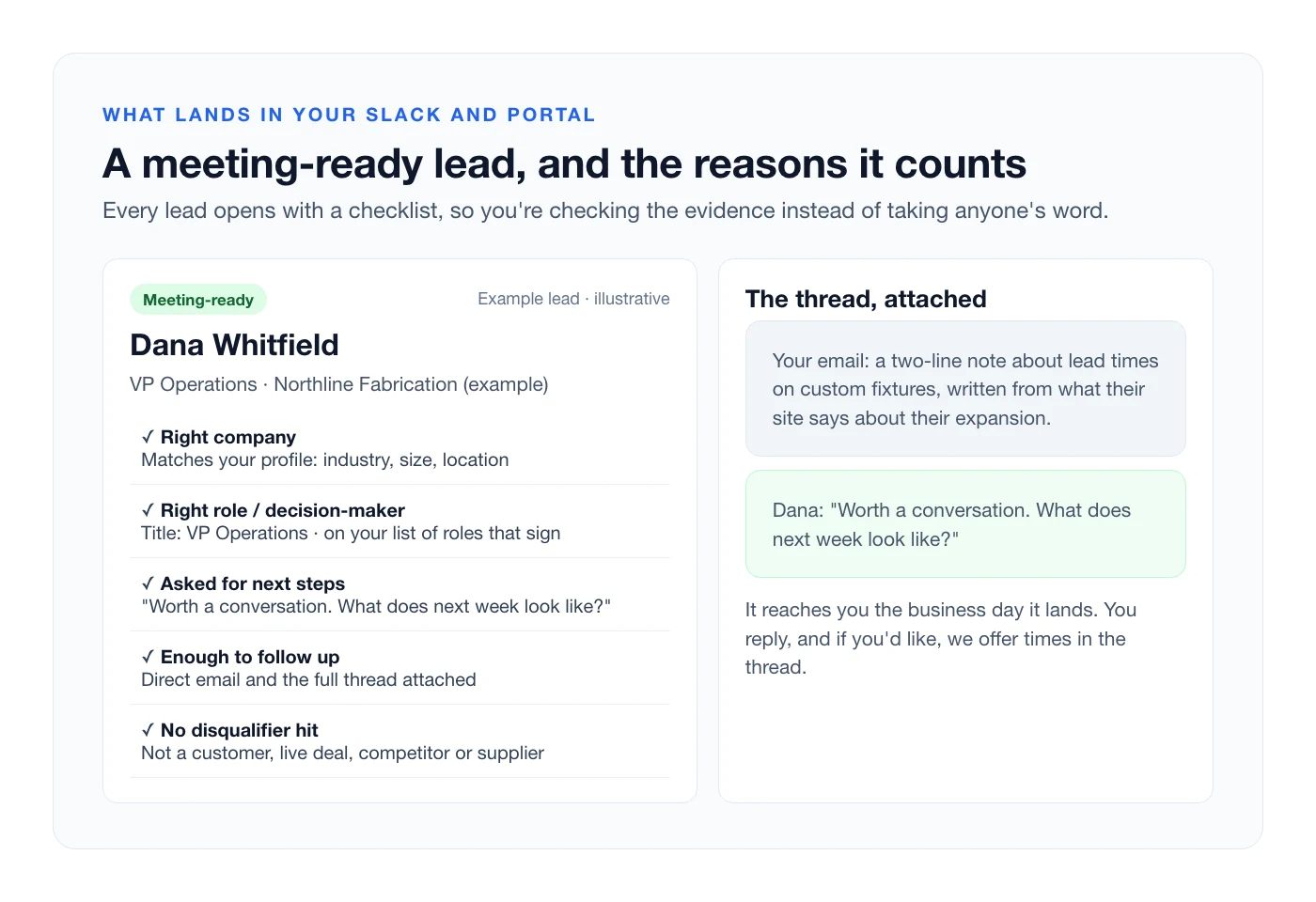
This is the card your team opens when a lead lands. The checklist shows why it counts, and the thread shows what they said.

An example meeting-ready lead card: a VP of Operations who asked for next steps, with a checklist of why they qualified and the email thread attached.
Example for illustration. The name, title and company are made up.

What a meeting-ready lead looks like in your portal.

Every lead lands in your Lead Tracker with the reasons it counts, what they said and a reply drafted for you. Click around: open a lead, switch tabs, change a status.

Lead Tracker

Track meeting-ready leads, update outcomes, and flag any that missed the mark.

NameCompanyDeliveredStatus
Dana Whitfield
VP of Operations
Crestline FabricationSep 26
▲ High priority · A🔥 HotNewWhy qualified ⓘAwaiting 3h
Marcus Oyelaran
Plant Manager
Northgate PlasticsSep 22
Medium priority · BWarmBookedWhy qualified ⓘResponded 12m
Priya Raman
VP, Operations
Halverson FoodsSep 17
Medium priority · BWarmNewWhy qualified ⓘResponded 1h
Tom Brezinski
COO
Lakeshore CastingsSep 9
Standard priority · CWarmContactedWhy qualified ⓘResponded 20m
Lead detail
Dana Whitfield
VP of Operations, Crestline Fabrication
Email:
dana.whitfield@crestlinefab.com
LinkedIn:
Profile
Phone:
(614) 555-0148
Delivered:
Sep 26, 10:42 AM
Source:
Cold email
Status:
New🔥 Hot▲ High priority · A
Speed to lead:
Awaiting 3h
Suggested reply

Thanks Dana. Tuesday at 2 or Wednesday at 10? I'll bring what the switch looked like for a plant your size.

Be ready for this

They're scheduling out of spreadsheets and rebuild it every Monday. Expect a question on how long the switch takes.

Why this qualified

  • ✓Right company: manufacturer, ~140 employees
  • ✓Right role: VP of Operations, on your list of titles
  • ✓Asked for next steps: wants 20 minutes next week
  • ✓No exclusion hit: not on your leave-alone list

The standard you set: "Ops leaders at US manufacturers with 50–500 staff."

Why this was billed

Included (coverage)
Their reply
Still spreadsheets, and it's a mess every Monday. Send me something and find 20 minutes next week.

Qualified because: a decision maker named the problem and asked for a call.

Intent: Hot

Conversation

Outbound · Sep 25

Hi Dana, is Crestline still scheduling second shift out of spreadsheets, or has that moved into a system?

Lead · Sep 26

Still spreadsheets, and it's a mess every Monday. Send me something and find 20 minutes next week.

Outbound · Sep 26

Thanks Dana. Sending an overview now, and Jess will reach out today with times.

Update status

Example for illustration, drawn from the portal's own screens. Names, companies and numbers are made up. Nothing you click is saved.

Why the deal protects you.

The agreement commits to coverage: 5,000 owners from your list contacted each full month, with the count in front of you every month, and every reply that asks for a quote, a meeting or a call passed to you the business day it lands. The fee is flat and the agreement is month to month, so every month has to earn the next one with replies you can check.

  • Industries we've emailed: commercial roofing, commercial cleaning, landscaping, mechanical contractors, pharma validation, welding cells, machine vision, water treatment, overhead cranes and packaging machines.

    Check it: Ask on the call and we will show you the Smartlead dashboard.

See how we build a campaign

What this runs on, and who else runs on it.

None of it is a private method. Each piece is one you can look up.

  • Sending runs on Smartlead. Verkada, Brex and Replit send from the same platform.

    On Smartlead's front page

    SmartleadVerkadaBrexReplit

    Check it: Their logos are on smartlead.ai's front page.

  • Your angle gets looked up before it gets written. We keep a reference library of 200 real cold-email campaigns from other senders, and check an angle against it before we write. They are other people's campaigns, not our results.

    Check it: Ask on the call and we will show you the table.

Who you're actually dealing with.

Travis Heurtelou

Founder

Travis Heurtelou

Travis worked at Fidelity Investments, Microsoft, Western Union and Meta, and saw how hard it is for B2B teams to build pipeline without a full outbound operation. He started Breezy Growth Co. to run that operation for them. You work directly with him, not a rotating account team.

  • Former Associate Software Engineer at Fidelity Investments
  • Former Program Manager Intern at Microsoft
  • Meetings booked at Google, LinkedIn, Palantir, Bloomberg, and more
  • Builds and runs the whole campaign: sending setup, lists, copy and replies
  • Bachelor's degree in Management Information Systems, Christian Brothers University

Worked at

  • Fidelity
  • Microsoft
  • Western Union
  • Meta

Booked meetings at

  • Google
  • LinkedIn
  • Palantir
  • Bloomberg

You work with me directly. I'm on the first call, I run the campaigns, and I answer the emails about your account. There's no handoff to an account manager after you sign. The person you talk to on the call is the person doing the work.

I also built the software — the reply screening, the portal and the Slack channel your leads land in. So when your campaign needs a change, it's an afternoon, not a ticket in somebody's queue.

You get my email address, and I'm the one answering it. If you want one accountable person instead of a bigger logo, that's what this is.

The math, on your numbers.

What one meeting-ready lead is worth to you. Hold the monthly fee against it.

Example inputs, from our thesis doc's math page: a customer worth $25,000 in gross profit, and 50% x 75% x 25% down the chain. That makes 9.4% of meeting-ready leads become customers.

So one meeting-ready lead is worth about $2,344 to you on average, whether that one closes or not.

The fee ÷ $2,344 = the meeting-ready leads a month that pay for it. The fee is one flat monthly number, $2,000 to $5,000 per month, the same whatever the number of replies, so about 1.5 meeting-ready leads a month cover it.

$

Example input from our thesis doc: $25,000. Use your gross profit over the life of the account, not revenue.

%

Assumption from our thesis doc: about half, when someone answers the same day.

%

Assumption from our thesis doc: about 3 in 4.

%

Your close rate. Example: 1 in 4. Use the one you'd quote your own team.

Your assumption, not our promise.

$

The fee is $2,000 to $5,000 per month. Put it in to see the result.

9.4%
Meeting-ready leads that become customers
$2,344
What one meeting-ready lead is worth
$9,375
What 4 a month are worth
—
What you'd pay a month
Put in the fee to see this.
—
Meeting-ready leads a month that pay for it
Put in the fee to see this.

What this leaves out

  • The rates multiply. Take a few points off each and see if it still holds.
  • Meeting-ready leads a month is your assumption, not our promise. We size your market on the call.
  • Month one is two weeks of warmup, so judge it on a full month of sending.

The things you're probably thinking.

I'd rather answer these here than have you sit on one for half the call. They've all come up before, and none of them is a reason to skip the conversation.

  • “How much does it cost?”

    $2,000 to $5,000 per month, flat, with everything on this page included. No setup fee and nothing else on the invoice. The first month bills when you sign. After that it's month to month with no minimum term, and you cancel by email at least 30 days before your next billing date.

  • “What if nobody asks to meet?”

    Triple Guarantee: fewer than 5 meeting requests by day 90 and three fixes run on their own, at no extra cost: more volume, a second list, then a full reset. Still under 5 after that, and that month's fee comes back. A meeting request is a reply that asks for a quote, a demo, a proposal, a scope call, a meeting or a call. The fixes, one month each: 2,500 more new companies on top of your plan; then a second list in a new segment, region or role, with up to 2,500 more; then a full reset of the angle, the emails and the targeting, contacting 10,000 that month, all of them new (or your plan plus 2,500 if that's more). If you still have fewer than 5 after the reset, that month's fee comes back to your card within 15 business days. Each fix runs for one month, in order, and only while the total is still under 5. You don't ask for any of it, the refund included, and there's nothing to claim or choose. It holds while you approve each draft within 2 business days, answer every reply within 1 business day, send the leave-alone list within 5 business days of signing, keep the offer, its price and the target market as agreed, pay on time, and do the rest of your part under §5. Days paused on your side don't count. It runs once per agreement. Step 4 is its one refund; otherwise no credit, no change to the fee, and the term doesn't extend. It's §8 of the agreement, where it's called the Triple Commitment. Start Commitment: if sending hasn't started 21 days after you sign because of us, your first month's fee comes back.

  • “Is a meeting-ready lead an actual booked meeting?”

    It means the person is ready to take one: they match your profile, they've replied asking for next steps, and the entire thread arrives with them, so nobody on your side is opening cold. Your team books it, and that takes one reply. If you'd like, we help get the call on your calendar by offering times in the thread. What this offer doesn't do is promise a number of meetings or leads a month. The agreement commits to coverage, 5,000 owners contacted a month, and every reply that asks for a meeting reaches you the business day it lands.

  • “What does the monthly fee actually pay for?”

    Everything: domains, inboxes, two weeks of warmup, data, verification, copy, the screening of every reply that comes back, and every meeting-ready lead the machine produces. It's one fixed fee, the same in a good month and a big one, and most of it goes straight back out to the domains, the inboxes, the data, the software and the hours. The volume side is ours. A market that turns out harder than it looked, ten thousand emails that go nowhere: none of it gets added to your invoice and none of it becomes your problem. A big month is entirely yours, because the extra leads cost you nothing.

  • “What does a big month cost me — am I signing up for a bill I can't predict?”

    Exactly what a small one costs. The fee is flat and every meeting-ready lead is included, so the bill is the same number every month whatever the machine produces. On the call we size the plan to what your team can work. Once it's running you can pause sending, and the fee stays the same while it's paused.

  • “How do I know these are decision-makers and not whoever happened to open the email?”

    Because the role is part of the targeting rather than a hope. Before anything sends we write down the titles that decide this in your market, in order, and the titles to leave alone. That goes into the onboarding form, and the list is built from it: one person per company, in that order. Then you get to check it: every lead you open shows their actual job title on a line reading right role / decision-maker, next to the rest of why it qualified. If the data is wrong or the title overstates the role, tell me and the targeting gets tightened from the next send. And when somebody junior replies, we work that thread to the person they name instead of forwarding you the redirect and calling it a result.

  • “I've been burnt by an agency doing exactly this before.”

    Then you already know what to check for, so hold this up against it. The usual version: they sent from your domain, nothing written down said what counted, and a lead meant anyone who replied. Here your own domain is never touched, the fee is flat with every lead included, and your disqualifiers go on the leave-alone list in the agreement, so a company you told us to leave alone is never emailed. Add to it by email any time and it takes effect within one business day.

  • “I've paid for leads before and they were bad.”

    Then ask what you were actually buying. In most of those deals a lead is a reply. Anyone who answers counts, including someone asking to be taken off the list, so the provider makes money by sending you volume and letting you sort it. Here the list is built from the profile you wrote down, one person per company in the roles you named, and your disqualifiers go on the leave-alone list, so nobody on it is emailed. You see the reply and how it matched your profile on every single one, so you're checking rather than taking my word for it. If one misses, send a line on why and the targeting gets tightened from the next send. And the fee is flat, so nobody here earns more by calling a weak reply a lead. Bring the last provider's definition of a lead to the call. That's usually where it went wrong.

  • “It'd be cheaper to just do this in-house.”

    Only until you price the whole thing: domains, inboxes, warmup, data, sending tools and a person reading replies daily — that bill starts before the first conversation. If you've got someone with three clear weeks and nothing else on, they genuinely should build it. If it'll be done in the gaps around somebody's real job, it stops the first busy week, and cold email that stops for two weeks has to be warmed again from scratch.

  • “Another agency quoted us less.”

    Ask what their fee covers and what your team still has to do. A lower quote usually pays for sending: the emails go out, you get a report, and every reply is yours to sort, answer and book. Here one flat monthly fee covers the domains, inboxes, data, copy, 5,000 owners contacted a month, the screening of every reply, and every meeting-ready lead that comes out of it. Bring their proposal to the call and we'll go through the two line by line. If theirs does the same work for less, take it.

  • “We can't pay that much up front.”

    The first month is paid when you sign, because setup and the two weeks of warm-up start that week. If the money is there next month, sign next month and we start then. The price and the work stay the same. If the problem is the total and not the timing, say so on the call. The fee is flat, so you know exactly what a month costs before you commit.

  • “Cold email is going to wreck my domain.”

    We never send from your domain. We buy separate domains and inboxes for sending, set up the authentication records, warm them for two weeks, and check the deliverability numbers every week. If one starts having problems we pull it out of rotation and replace it, and that's our cost, not yours. Your own domain keeps doing what it does now — your real email, your website, your existing customers. Nothing we run touches it.

  • “How long before I see anything?”

    Two weeks of warmup before anything sends, then sending starts once you've approved the copy, and the first replies come back inside the week after. Month two is the first full month. How many replies come back depends on your market and your offer, and the agreement promises no number outside the Triple Guarantee. What it commits to is 5,000 owners contacted a month. We size your market on the call, and if it can't carry the fee, you'll hear it from me on the call.

  • “How much of my time is this going to take?”

    About an hour to start and ten minutes a week after that. Onboarding is one call and a form: who you sell to, who to leave alone, what you sell, and anything we shouldn't say. You approve the copy once before anything sends. After that the leads land in your inbox and in the portal with the whole thread attached, and you reply to the ones you want. Nothing sits waiting on you, and when I need a decision I ask for it in one line.

  • “Is cold email even legal?”

    Business to business, yes, and here's exactly how we run it. We email work addresses at companies, never personal ones. Every email comes from a real inbox with a real name on it, and every reply that comes back is screened the same business day. Anyone who replies asking to be taken off is suppressed immediately and never contacted again by any campaign we run, for any client. And none of it goes out from your domain, so none of it lands on your reputation. If you sell into the EU or the UK, say so on the call — the rules there are different and it changes how we build the list.

  • “I already have someone doing outbound.”

    Then keep them. This runs on separate domains and inboxes, so nothing we send touches what they're sending. It also doesn't compete for their time: nobody on your side is building lists, warming inboxes or working an inbox on top of their real job. Bring their numbers to the call, how many they send a week and how many replies come back, and if you're better off fixing what you already have, I'll tell you that instead.

  • “What if I get the leads and none of them close?”

    Then something's wrong with the market, the offer or the pitch, and it shows up in the threads before it shows up in your numbers. We screen every reply, so you hear what people are pushing back on and we change the copy or the list. What I control is who lands in front of you: right company, right role, replied asking for next steps. What happens in the conversation is your side. That's why we do the math before you sign — your deal value and your close rate decide how many leads this has to produce to be worth running, and if that number is out of reach for your market I'll say so on the call.

  • “What if it works and I can't keep up?”

    We reach out to 5,000 owners a month, and on the call we check that against what your team can take. Once it's running, we can pause sending if you need a break. The fee stays the same while it's paused and the term doesn't extend, so for a long break, 30 days' notice ends the agreement instead.

  • “You haven't done this in my industry.”

    Ask me on the call and I'll tell you straight whether we've sent into it. What carries between markets is the machine: the list, the infrastructure, the copy testing, and the screening of every reply. What doesn't carry is the market itself, and that's what we size on the call before you sign. The fee covers the rest: it's flat, so the sending it takes to learn your market is my cost, not yours.

  • “Can I just try it for a month and see?”

    Two weeks of those thirty days are spent warming domains before anything can send, so what you'd actually be judging is two weeks — and I'd rather tell you that now than take a month that can't show you anything. There's no minimum term either way — 30 days' written notice before your next billing cycle, throughout. What I do about it is front-load: infrastructure in week one at no extra cost, copy in your hands before anything sends, and your portal showing what went out and every reply from the week sending starts, so you're watching it fill rather than waiting in the dark.

  • “My market is too niche for this to work.”

    We can answer that in thirty minutes instead of sixty days. We size it before you sign: how many companies match your profile, how many are reachable, how much sending it takes to earn a reply in your category. Small and specific is often the best case here, because the copy can be exact. If the number genuinely can't carry a fee worth paying, you'll hear that on the call and get pointed somewhere better instead of sold something your market can't carry.

  • “It's one person. What happens if something happens to you?”

    Nothing of yours is trapped here, and while it runs, emails to me get an answer the same business day. The agreement is month to month with 30 days' notice, so there's no prepaid year at risk. Every reply and thread passed to you is yours and stays yours, and they're already in your own Slack channel as they land. The sending domains are ours, which is what kept your domain out of it, so if the machine stopped tomorrow your own email and your own reputation are exactly where they were. The one thing you'd lose is the machine itself, and rebuilding one takes two weeks of warmup no matter who builds it.

  • “I need to run it past my business partner.”

    Bring them along. Nothing gets signed on the call, and the questions they'd ask are ones I'd much rather answer live than have relayed second-hand. If they can't make it, send them this page — it's the entire offer, and it says the same thing whether I'm in the room or not.

  • “We're doing fine on referrals. Why change anything?”

    Referrals are the best lead you'll ever get and the one thing you can't schedule. You can't tell me how many arrive in November, so you can't hire ahead of them, and a quiet quarter is something that happens to you. What cold email adds is a second source with a number on it: contacts go out every week, the right people write back, their replies land with you the day they come in, and next quarter's pipeline stops depending on who happened to mention you. Keep every referral. The point of the machine is that you can forecast around it. On timing: the inboxes need two weeks of warm-up before the first email, so the month you decide is the month before anything sends. Deciding in the quarter you're worried about is already late.

  • “What do you need access to?”

    Nothing you'd have to think twice about. No inbox access, no password, no CRM login. Emails send from domains and inboxes we build, so nothing runs through your accounts. You get a Slack channel where every reply that asks for a next step lands with the full thread, and the same thing in the portal. The whole setup on your side is the onboarding form, the onboarding call, and approving the copy once.

  • “Is there anything I'll end up paying for on top?”

    No. Domains, inboxes, warm-up, data, verification, the software the whole thing runs on, and the screening of every reply are all inside the fee. Nothing on the deliverable list is billed separately and nothing on it is an upgrade. There's no setup fee and no infrastructure line. Everything that can appear on your invoice is on the paper before you sign it.

  • “We tried cold email ourselves and it did nothing.”

    Almost every in-house attempt fails the same three ways, and none of them is the copy. It sent from your own domain, so it hit spam within a week and took your real email with it. It sent to a list somebody exported, so half the addresses bounced and the rest were the wrong person in the building. And nobody's job was to read the replies, so the two people who did write back waited three days and went quiet. What we run fixes each one before the first send: separate domains warmed for two weeks, lists verified and built around the person who signs, and every reply screened the day it lands. The thing you tested was the idea. This is the machine.

  • “What if you send something that makes us look bad?”

    You see the copy before anything sends and approve it once before launch. It's written to sound like you, not like an agency, and it's short, it's about them, it makes one clear ask, and anyone who asks to be left alone is removed and never contacted again. It also goes out from domains we build, so your reputation isn't the thing being spent to find these people. A reply that comes back annoyed is closed the same day, never worked. In practice the people who don't want it ignore it, and the ones who reply are the ones who've been meaning to fix this.

  • “How fast does a reply get screened, and does the sequence stop?”

    Every reply is screened the same business day. The emails to that person stop the moment they answer, so nobody who has already written back gets a follow-up. Every reply that asks for a quote, a meeting or a call lands in your portal and your Slack channel the business day it arrives, with the whole thread attached.

  • “Will I only get a monthly report, or can I see it happening?”

    You see it as it happens. Your portal shows what was sent, every reply, and how each one was marked against your bar. On top of that, each month you get the count: companies contacted that month, contacted to date, left to contact, and removed and why.

  • “What happens if I'm slow to get back to a lead?”

    It goes cold, and quickly. A reply that asks for a next step lands in your Slack channel and the portal the business day it arrives, with the thread attached, so the answer is one reply from you, not a cold call. Roughly half convert when someone answers the same day, and that number falls with every day the thread sits, which is why response time on your side is one of the numbers we look at together on every check-in. The agreement asks you to name someone who answers every one within about a business day. If nobody on your side can, say so on the call.

  • “How long have you been doing this?”

    A founding date won't tell you whether this works for your firm, so check these instead. You approve the copy before anything sends. From the first send, your portal shows what went out and every reply that came back, so you're judging the work itself within the first month. And you're never held past the term in your agreement.

  • “Who pays you? Do you work for the companies you email?”

    You pay us, and nobody else does. We don't represent the companies we email and take nothing from them. We write to them about your work, and when one asks for a next step, the conversation is yours.

  • “Are these people already looking, or are you cold-emailing them?”

    Cold-emailing them. We write to the person who signs for this kind of work at companies that fit your profile, and most of them have never heard of you. You only hear about the ones who write back asking for a next step, so anyone who reaches you has already put their hand up.

  • “Why did the email come from a company name I didn't recognize?”

    The email you got went out from one of our sending domains, kept apart from breezygrowthco.com on purpose so a complaint or a spam filter never touches the main one. Your campaign gets the same protection: it runs on separate domains and nothing goes out from yours. Everything after the first reply is us by name: this page, the call and the agreement.

  • “Can I talk to one of your clients first?”

    We do not put a client's name on a page and we do not arrange calls with clients; their time is theirs. What you can check without us: the free 10-lead preview of your own list, the agreement and its guarantee, and our own counted figures. From the first month you also see every reply we pass you, with the full thread, and judge the work yourself.

  • “How do I know the replies you send me will be any good?”

    You set the bar before anything sends: who we go after and who we leave alone. Every company on the list is checked against that profile before the first email goes out. Every reply is screened, with a person on anything borderline, and marked against your bar. You get the full thread on each one we pass, so if we're sending you the wrong people you'll see it in the first few weeks and we fix the list.

What I'll ask you on the call.

Most of the call is about your business and your buyers, not about us. Have the answers to hand and the half hour goes further.

  1. 1

    Who answers a new qualified reply today, and how fast does it get a reply?

  2. 2

    How many new customers can your team take on in a month before quality slips?

  3. 3

    What is a typical new customer worth to you in margin, and how many of those customers come back?

  4. 4

    Which kinds of customers have you never been able to reach?

  5. 5

    What does your best customer from the last year have in common with the rest?

What actually happens on the call.

Thirty minutes, five things, in this order. It's a working conversation, not a pitch — and if the first four say no, we don't get to the fifth.

  1. 1

    What you sell and who buys it

    Specifically. The vaguer this is, the more of your money we'd waste finding out.

  2. 2

    What a customer is worth to you

    Average deal value and roughly what share of good conversations close. Those two numbers decide whether the economics work at all, and they're not hard to get to.

  3. 3

    Whether your market is reachable by email

    Do your buyers read their own inbox, can we find enough of them, do they buy more than once. If the answer is no, I'll say so on this call and point you somewhere better rather than sell you something your market can't carry.

  4. 4

    What we'd actually run

    The list, the angle, the volume, and what the first month realistically looks like.

  5. 5

    Price and how we'd start

    Only if the first four hold up. We size your market, put the flat monthly number in front of you, then scope and what happens Monday.

  • Your average deal value
  • Roughly what share of good conversations you close
  • The job titles that actually sign this off in your market — and the ones that never do
  • How many new customers a month you actually want — and could handle
  • Anyone else who'd have to agree before this could start
  • No deck, and no forty-slide walkthrough of the software
  • No second meeting to get the price. You get the number on this call, so you can weigh it against anything else you're looking at before you decide
  • No guaranteed number of meetings or leads outside the Triple Guarantee. What the agreement gives you instead is coverage, 5,000 owners contacted a month, with the count in front of you, and one flat bill that doesn't move
  • No pressure. If cold email is wrong for your market, saying so costs me thirty minutes and saves you a lot more than that

And if it's a yes, what happens next.

Nothing gets signed on the call. The sequence runs from the end of our thirty minutes to the first lead landing, including the two weeks where nothing sends.

  1. We scope what we'd actually run

    The list, the angle, the volume, and what month one realistically looks like for your market specifically. If the market can't carry it, we stop there — that's a real outcome, not a soft no.

  2. The agreement and the first invoice, in one email

    Not a proposal, not a follow-up deck. The actual agreement with the scope we just agreed written into it. The signing link stays live for five days — long enough for a colleague or a lawyer to read it properly, and it isn't a countdown designed to rush you.

  3. A short form, then a call — and the disqualifiers

    The form covers your offer, your ideal customer, and who's plainly wrong for you. Spend your time on that last part: your disqualifiers go on the leave-alone list, and nobody on it is ever emailed. Then a short call to fill the gaps.

  4. Infrastructure goes up and the first lists get built

    Separate sending domains and inboxes bought and configured, authentication records set, lists built from your profile and verified, first copy drafted. Your own domain isn't touched at any point in this — that's the part that makes it safe rather than just effective.

  5. Warmup — nothing sends, and it can't be skipped

    New inboxes that start sending at volume land in spam, and once a domain is burnt it stays burnt. So the first two weeks are warmup, on every campaign, for everyone. If you need results inside thirty days, this is the wrong service and I'd rather you knew that here than in week three.

  6. You approve the copy

    You see the sequences before a single prospect does. Nothing that describes your offer sends until you approve it in writing, and an email is enough. After that we can rewrite subject lines and openings without asking, as long as nothing new is said about your offer. It's the last gate that's genuinely yours, and it's the one place the whole thing can be adjusted at no cost.

  7. Campaigns run, and every reply gets screened

    Every reply is screened against your criteria. Every reply that asks for a quote, a meeting or a call lands in your portal and your own shared Slack channel the business day it arrives, with the full thread attached and marked against your profile. Out-of-office replies, opt-outs and bounces stay with us. Each month you get the count: companies contacted that month, contacted to date, left to contact, and removed and why.

  8. Month to month, 30 days' notice

    No minimum term and no renewal to negotiate — 30 days' written notice before the next billing cycle ends it, and the cycle you're in runs out rather than being prorated. If a lead misses your criteria, tell us with a line on why and the targeting gets tightened from the next send.

Two of those steps sit on your side of the line — the disqualifiers and the copy approval — and they're the two that decide how much of what you receive is worth having. Everything else runs without needing anything from you until a lead lands, and then it needs one thing: someone free to follow up within a day or two, because a warm reply going cold on your side is the one failure this whole machine can't protect you from.

Whether this is for you.

  • You sell B2B
  • A customer is worth more than $5,000 to you in gross profit over their lifetime
  • You have a clear idea of who your best customer is
  • Someone on your side can actually work the leads within a day or two
  • You can give it a runway — the first two weeks are warmup, not results
  • You sell to consumers
  • Deals under $5,000
  • No clear ideal customer yet — we'd be guessing, and you'd be paying for it
  • Nobody free to follow up — leads go cold fast
  • You need results inside thirty days

If your market doesn't fit, I'll say so on the call. I follow up once after we talk, then leave it with you.

Straight answers.

Will you email my existing customers, or people I'm already talking to?

Not if you tell us who they are. Before anything sends you give us the domains to leave alone — customers, live deals, partners, anyone. They go on your suppression list and never get contacted. Send them as domains or email addresses rather than a description, and you can add to the list at any time; it applies to every campaign on your account from that moment. You also see the first ten prospects before anything goes out.

Do I own the sending domains and inboxes?

No, those are ours and they stay ours — which is the same reason your own domain is never at risk from any of this. What's yours is every reply and thread passed to you, and each monthly count. The list and the contact data stay ours, because they're licensed for this work. If you cancel, you keep every reply and thread, and a reply that arrives within 30 days after the end still comes to you.

Am I locked in?

No. Month to month, no minimum term and nothing to renew — you cancel with 30 days' written notice before the next billing cycle, and the one you're in finishes rather than being refunded back. The only thing keeping you here is that it's working — which is why the machine gets built to produce in month two.

Is this just AI spam?

No. AI does the research — reading a prospect's site, their hiring, what they've announced — and drafts from what it actually finds rather than a template with a name swapped in. A human reviews before anything sends, and every reply is screened against your criteria before it reaches you. The list does too: one person per company, in the roles you named, so a generic blast would burn our domains and produce nothing worth passing on.

Do your other clients get the same leads?

No, and competitors never count. At onboarding you give me the competitors, or whole categories, you want excluded. They go into your file as disqualifiers, and disqualifiers are checked every time a reply is judged. If a reply trips one, it doesn't count as a lead. Competitors can go on your leave-alone list too, and nobody on it is emailed. One limit to know about: the same company can be in two campaigns for two clients who don't compete. The check is your disqualifier list applied when each reply is judged — not software cross-checking every other client's list.

Where does the data come from, and what happens to it?

Contacts come from public and commercially licensed sources, verified before anything sends, and go out from sending domains and inboxes we buy and warm for the purpose — never yours. Every message comes from a real inbox, every reply is screened the same business day, and anyone who replies asking to be taken off is suppressed across every campaign we run, permanently, not just yours. Every reply and thread passed to you is yours and stays yours if you leave. One thing to be straight about: we don't hold a compliance certification, and I won't pretend we do. What I will do is walk your legal person through exactly how it runs, on the call or after it — and it stands up to the questions they'll actually ask.

Can I try it for one month?

Don't sign up planning to judge it on month one. The first two weeks are domain setup and warmup, so month one is about half a month of sending. Three months is the shortest fair test of any way of finding customers. Judge it on months two and three.

Can you do it cheaper?

No. The price covers the domains, inboxes, data, sending and the screening of every reply. A cheaper version drops one of those, and what gets dropped is usually list quality or reply handling, which is where the leads come from. If the price is a stretch, the budget isn't there yet.

Do you guarantee closed deals?

No. We control who gets emailed, what they read and which replies reach you. Whether a lead becomes a customer depends on how fast you call back, your price and how you run the call. Anyone promising closed deals is either charging enough to cover the ones that don't close or planning to stop sending leads once it costs them.

Can I pay only when I close a deal?

No, for any client at any deal size. Our part is done when the lead reaches you. The close happens on your side, on your timeline, where we can't see it or change it. If that's the only way you'd work with us, please don't book.

See you on the call.

Your join link is in the Calendly confirmation email — search your inbox for Breezy. The same email has the reschedule link if something moves; use it rather than dropping off, and I'll work around you.

If something on this page raised a question you'd rather have answered before we speak, just reply to that confirmation email. It comes straight to me.

Want the whole argument before the call? Read the full thesis doc.

Travis Heurtelou — Founder, Breezy Growth Co.

What it costs, and what it is measured against.

How many customers pay for a year of it

Twelve months of fee is $24,000 at $2,000 a month and $60,000 at $5,000 a month. Divide by what one customer is worth to you.

One customer is worth1Customers to cover a year at $2,000/moAt $5,000/mo
$10,0002.46.0
$25,0000.962.4
$50,0000.481.2
$100,0000.240.60
$250,0000.100.24

1 The values are examples, not anyone's market. Use your own on the call.

If one customer covers the year, the fee is a small risk. If you would need more customers than this channel could plausibly win you in twelve months, say so on the call and we will say so too.

What you are choosing between

Cold email gets run by you, by someone you hire, by the cheapest agency willing to promise a number, or not at all. Those are the four, and you're weighing them already.

OptionCostWhat is good about itIn practice
Run it in-house yourselfTooling, plus somebody reading replies every dayNobody knows your offer the way you do, every tool involved is buyable, and there's no margin going to anybody else.Domains, inboxes, warmup, data and sending tools are a monthly bill before the first reply, and someone has to handle every reply every day. The money isn't even the expensive part — the first serious mistake burns a domain permanently, and you don't find out for sixty days. Then you're rebuilding from scratch.
Hire an SDR$5,000–7,000/mo loaded · 3–6 months to productiveYours, on your accounts, in your building — and a good one compounds into someone worth more in year three than the day they started.Salary and tooling go out before they've booked anything, it's three to six months before they're useful, and a real share don't work out — which you only learn over their first two quarters. They also show up without infrastructure: you're still buying the domains, the data and the sending tools, and now you're paying someone to learn them on your time. One seat is sixty to eighty-four thousand a year before tooling; a team of two with someone managing them and the data stack under it clears two hundred thousand a year, to keep the same emails going out.
The agency that guarantees you meetingsA fee billed with no written bar for what countsA number on a page is easy to sign off and it looks like the risk has moved to them. On the face of it, the safest option in the room.Ask them what counts as a meeting and where that's written down. If it isn't, the count gets hit by sending you whoever replied, and you find out around month three, after thirty calls that closed nothing. Ask them what they don't bill you for — the answer is usually nothing.
Leave it and stay on referralsFree, until referrals go quietReferrals close better than anything else you do, cost nothing to acquire, and arrive pre-trusted.They come on their own schedule, which is never the quarter you need them. And it's the one channel you can't turn up — the month it goes quiet is the month you find out you don't have a second one, and building a second one from a standing start takes two weeks of warmup before it can even send.

Why it is a range

  • Two things set it: how many companies we email each month, and how many sending inboxes that takes.
  • A small, tight market needs fewer of both and sits at the low end. A large market, or one we have to cover quickly, needs more and sits higher.
  • On the call we count the companies in your market, so you see the size of the list before you see the number. You get one number, the same every month.

What the fee covers

  • Domains and inboxes, bought, set up and warmed.
  • Building the list, and checking every address twice.
  • Writing the emails and changing them as replies come in.
  • Reading and sorting every reply the same business day.
  • Every reply that wants to talk, handed to you with the full thread.
  • The reporting: companies contacted this month, to date, left to contact, and removed and why.

It is the whole invoice. There is no setup fee, no charge per lead, no charge per reply, and a hard month for us does not become a bigger bill for you.

The most you are ever committed to

  • Month to month. You cancel with 30 days' written notice, and you are never held past the cycle you are in.
  • If sending has not started 21 days after signing for a reason on our side, the first monthly fee is refunded.
  • The Triple Guarantee above covers the result, in section 8 of the agreement.
  • Every reply and thread we pass you stays yours if you leave.

Competitors, data and leaving, from the agreement

QuestionAnswerAgreement section
Who else do you run in my market?Anyone, a competitor of yours included, to the same facilities: the agreement is non-exclusive. Instead, your leave-alone list comes off before every send, every reply we pass you is yours to work, and your list, emails and pricing are not shown to anyone without your written consent.7(A), 6(A), 7(B), 12(D)
Who owns the data and the list?Every reply, thread and monthly count we pass you is yours, and on request you get a spreadsheet of each facility on the list (name, address, type) to keep. The contact data, the domains and inboxes and the emails stay ours.12(A), 12(B)
What does it cost me to leave?The billing period you are in. There is no minimum term: email us at least 30 days before your next billing date and it ends with that period, which is not prorated or refunded. A reply to an email we sent before you left still reaches you if it arrives within 30 days.11(A), 11(B), 11(D)

Read the agreement first

Read the agreement before the call, so the call is about your market and not about terms.

Read the agreement

What a careful buyer asks, answered in writing.

Where to find each answer

Who we email, and who we never email

  • We email work addresses at companies, never personal ones.
  • Every address goes through two separate email verifiers before it is loaded.
  • The list is built to the job titles that decide this purchase. The people you never want contacted go on a leave-alone list you send us within 5 business days of signing, and nobody on it is emailed.
  • Anyone who replies asking to be taken off is suppressed at once, for every campaign we run, not just yours.
  • Every email comes from a real inbox with a real name on it, on domains we set up for this. None of it comes from your domain.

From signing to the first send

In the order it happens.

  • The first two weeks are domain setup and inbox warmup. Nothing is sent to your market yet.
  • You get a 10-lead preview of the list and the copy, and you approve both. We ask for an answer within 2 business days.
  • Sending starts after approval. If it has not started 21 days after signing for a reason on our side, the first monthly fee is refunded.

What you will see, and when

  • Weeks 1 and 2: setup, warmup and your approval of the list and copy.
  • Month 1: about half a month of sending. The first replies come in, and each one is screened the same business day before it reaches you.
  • Months 2 and 3: the fair test of the channel. Judge it on these two, not on month one.
  • Day 90: the check in the Triple Guarantee runs on its own. You do not file a claim.

What we do not do

  • We do not take a cut of the deals you close, for any client at any deal size.
  • We do not send from your domain.
  • We do not email personal addresses.
  • We do not send anything to your market that you have not approved.
  • We do not hand you a tool and a login to run yourself. We run the operation.

What happens to a reply

  • Each reply is read and sorted the same business day: interested, no, wrong person, out of office.
  • A reply that wants to talk reaches you with the full thread, so you start the call knowing what was said.
  • We ask you to answer it within 1 business day. A warm reply that waits a week is a lost reply, and the guarantee depends on it.

If it does not work

  • Month one is not the test. Months two and three are.
  • The Triple Guarantee above is the written answer: three fixes run on their own at no extra cost, and if the result is still short after the reset, that month's fee comes back to your card. It is section 8 of the agreement, and you read the agreement before you sign.

How we work, shown on our own markets.

These come from our own campaigns and tests. No client result is claimed on this page.

Our own campaigns, 1 August to 16 October 2026

Before we run anyone else's, we run our own. These are counted, not rounded up.

  • We emailed commercial roofing, commercial cleaning, landscaping, mechanical contractors, pharma validation, welding cells, machine vision, water treatment, overhead cranes and packaging machines.
  • 14,947 emails sent. 167 bounced, about a 1% bounce rate.
  • 56 owners and managers replied with real interest in what we offered. We counted them by reading every reply, one at a time, and set aside the out-of-office and wrong-person replies and the suppliers who wrote back to say they sell the same thing.

Figures are from our sending platform as of 16 October 2026, with the interest count made by hand. They count emails sent and replies from people, not clients. We publish no reply rate: the campaigns ran in ten different markets, with different lists and different copy, so one rate would tell you nothing about yours. Calls agreed and calls held are not printed here, because we only print what we have confirmed.

One market, start to finish: independent forklift dealers

What we do before a single email goes out, shown on a market we tested in October 2026 for ourselves.

  • The buyer is written as one sentence first: independent US dealers that sell, rent and service lift trucks, not owned by the manufacturer.
  • The exclusions are written next: manufacturers, parts-only sellers, auction and used-equipment resellers, warehouse operators, crane companies, vehicle and trailer dealers, and dealers owned by a parent group.
  • Then a test before any build. We pulled 40 companies and scored each one against that sentence, reading its own website. The rule was set in advance: build only if at least half are the buyer and the market holds at least 40 firms.
  • It passed. 25 of the 40 were clearly the buyer, 12 were not and 3 were unclear.
  • We ran the same rule on four other markets that week. Three failed and one needed a hand check, and we did not build any of the four.
  • A hand check of the passing list cut it again, and not every company had a decision-maker email we could find and verify. The list we send to is smaller than the market, and we say so.

As of 18 October 2026 this campaign had not sent its first email, so no result is claimed for it. It is here to show the method.

Operating record

Markets we screened, took and killed for our own campaigns, with the date and the reason. Most markets fail before a list is bought.

DateMarketDecisionReason
16 Oct 2026Welding cell integratorsStoppedNo replies to the first email. Stopped.
16 Oct 2026Machine vision integratorsStoppedNo replies to the first email on a short list. Stopped.
16 Oct 2026Data-center equipment makers, cost segregation firms, dealership builders, safety and PPE makers, building controls contractors, wire-harness makers, build-to-suit developers, geotechnical and testing firms, nuclear-code fabricatorsKilledEach failed a sample test before any list was bought. Once group-owned, private-equity-owned and small firms came out, under half of the sample was the buyer or too few firms were left.¹
17 Oct 2026Independent forklift and lift truck dealersTaken25 of 40 sampled companies were the buyer, above the bar. The campaign is shown in full above.²
17 Oct 2026FAA Part 145 repair stationsKilled9 of 45 sampled companies were the buyer.²
17 Oct 2026Hydraulic cylinder and pump repair shopsKilled7 of 39 sampled companies were the buyer.²
17 Oct 2026Commercial kitchen equipment service agenciesKilled3 of 39 sampled companies were the buyer.²
17 Oct 2026Motor, generator and pump rewind shopsNot taken7 of 40 clearly the buyer and 13 unclear, which needs a hand check. We did not spend on one.²
18 Oct 2026Aerial lift and scissor lift dealersKilled12 of 35 sampled companies were the buyer, and many of them already sit on the forklift dealer list.²
18 Oct 2026Floor scrubber and sweeper dealersKilled1 of 40 sampled companies was the buyer.²
18 Oct 2026Racking and conveyor integratorsKilled7 of 39 sampled companies were the buyer.²
18 Oct 2026Air compressor distributorsNot taken12 of 40 clearly the buyer and 10 unclear, which needs a hand check. We did not spend on one.²

¹ These were screened by hand from directories and registries, and each sample was read under a strict and a generous standard, so no single count is shown.

² Sample test: companies pulled from a contact database and scored by reading each company's own website against a one-sentence description of the buyer. The bar is set before the test: at least half must be the buyer and the market must hold at least 40 firms. Counts are the scored rows in our test report for that market.

How each kind of reply is handled

The replyWhat happens
Asks to be removedsuppressed at once, for every campaign we run, and not emailed again.
Out of office, left the company, autoresponderkept apart from real replies and never counted as one. An address that has left the company comes off the list.
Not interestedmarked, and nothing more is sent to that person.
Wrong personmarked as wrong person, never counted as interest.
A question about what we sellanswered from what is written in the agreement. Nothing is promised that is not on paper.
Asks for a quote, a demo, a proposal, a scope call, a meeting or a callpassed to you with the whole thread, the company, the person and their title, the business day it arrives.

Every rate we judge a campaign on uses contacted as the bottom number, never replies, because a single dead mailbox can auto-reply on every send.

Where the data comes from and how it is checked

  • Companies: public registries and directories for the trade, such as licensing lists and trade association members, and business listings.
  • Fit: each company's own website is read and scored against the one-sentence description of your buyer, before anything is paid for.
  • People: the job titles that decide this purchase, found in contact databases, and only for companies that passed the fit check.
  • Email: every address goes through two independent verifiers. An address either one marks invalid is never loaded.
  • Duplicates: a campaign that would email someone already emailed is paused automatically.
  • The order is cheapest check first, so money is spent on the companies that already look right.

Every fact in an email has a source

When an email says something about the company it is sent to, that line has to be on the company's own website.

  • The check reads the company's home, about and services pages.
  • It is plain text matching, not a model's opinion. Every number, year and name in the line must appear on those pages, and at least 70% of the other words must too.
  • A spelled-out count such as "six technicians" always fails, because it cannot be matched safely.
  • If the site cannot be read, the line counts as unproven.
  • A line that fails is removed before the leads are loaded, and that company gets the email without it.
  • What it does not check: a line taken from a job posting comes from the posting, so it is not matched against the website. It also checks that the words are on the page, not that the page is up to date.

Illustrative only. Example Pump Works is an invented company, and these lines were written for this example.

Line in the draft emailWhat the company's site saysResult
You've built vertical turbine pumps since 1987.Home page: "Building vertical turbine pumps since 1987."Kept
You opened a second plant in Ohio last year.No page mentions Ohio or a second plant.Removed. The email goes without it.
Your six field technicians cover three states.A spelled-out count, which the check cannot match.Removed. The email goes without it.

You can check this yourself. Every line about a company in your 10-lead preview should be findable on that company's website. How the check was tested

Your first 30 days, in order

A plain timeline, not a promise of results.

  1. Day 1You sign. We book the onboarding call or form and ask for your leave-alone list, due within 5 business days.
  2. Days 1 to 14Domains and inboxes are set up and warmed. Nothing is sent to your market yet.
  3. During warmupWe build the list and write the emails. You get a 10-lead preview and the copy, and we ask for your answer within 2 business days.
  4. After approvalSending starts. If it has not started by day 21 for a reason on our side, the first monthly fee is refunded.
  5. Week 3The first emails go out and the first replies come in. Each one is screened the same business day, and the ones that want to talk reach you with the thread.
  6. Week 4The first 20-minute monthly review, and your first count: companies contacted this month, to date, left to contact, and removed and why.
  7. Day 30Month one closes with about half a month of sending. It is not the test. Months two and three are.

How I run it

  • I test every market on our own campaigns before I sell it to anyone.
  • I stop a campaign that is not working. I do not leave it running to look busy.
  • Each campaign is one email, because in our own sends most replies came from the first one.
  • I do not promise a number of meetings. I tell you what counts, and what we do if it falls short.
  • You can put any agency checklist next to this page and score us. That is why the answers are written down.

Travis Heurtelou, founder

What you receive, who does what, and the words we use.

The monthly count

The layout of what you receive each month. This shows the rows, not real figures.

Companies contacted this month

How much of the list we covered since the last count.

Contacted to date

The running total since sending started.

Left to contact

How much of your market is still untouched.

Removed, and why

Each company taken off the list and the reason: asked to be removed, bounced, wrong fit, or on your leave-alone list.

What a reply looks like when it reaches you

A layout, not a real lead.

Company

The business that replied.

Person and title

Who wrote, and their role.

Their reply

In their words.

The thread

Every email in the conversation, so nobody on your side starts cold.

Does it match?

A short checklist: right company, right role, asked for next steps, not on your leave-alone list.

The onboarding form and the leave-alone list

  • The form asks for your company name and website, who you sell to in a sentence, and which job titles decide the purchase.
  • The leave-alone list is a plain spreadsheet or list: one company name, domain or email per row, with an optional reason. Nobody on it is emailed.
  • We ask for it within 5 business days of signing, and you can add to it at any time.

The monthly 20-minute review

  • The count: what was covered and what is left.
  • The leads: which met your criteria and which missed.
  • Which leads became customers, so we know what to send more of.
  • What we change next month.
  • Anything on your side that is holding it up.

Four ways to do it, side by side

Who does the work

You
Someone you manage
The agency
We run the whole operation

Cost shape

Tooling every month, plus someone reading replies daily
$5,000 to $7,000 a month loaded
A fee billed with no written bar for what counts
$2,000 to $5,000 a month, flat

Before the first email

Domains, warmup and tools to buy and learn
Three to six months to be productive
Depends on the agency
About two weeks of warmup

Risk to your own domain

Yours is the one at risk
Ask them
None. We send from separate domains

What counts as a result

Whatever you decide
Whatever you decide
Ask where it is written down
Written in the agreement

How you leave

Stop paying for tools
A hiring decision, not a notice period
Read the contract
30 days' written notice

Who does what

Domains and inboxes

Set up, warm and watch them
Nothing

Your buyer

Write it down in one sentence
Confirm it

The list

Build it and check every address twice
Send your leave-alone list

The emails

Write them and change them as replies come in
Approve the preview and copy

Sending

Send, monitor and pause on a problem
Nothing

Replies

Read and sort each one the same business day
Answer the ones that want to talk

Reporting

Send the monthly count
Join the 20-minute review

Customers

Use it to aim the next send
Tell us which leads became customers

Your 30, 60 and 90 day scorecard

Day 30

Sending has started, you have the count, you approved the preview, and replies are being sorted the same day.
No count. Or sending has not started and nobody told you why.

Day 60

The leads that reach you match your criteria, the review is happening, and you have answered every warm reply within a day.
Leads keep missing your criteria after you told us. Or replies are sitting unanswered, on either side.

Day 90

The guarantee check has run on its own, and you know what your market answered.
Nobody tells you where you stand at day 90.

Where in the range you would land

Three example markets. They are illustrations, not quotes, and we size yours on the call.

A narrow trade in one region

A small list, so fewer companies and fewer inboxes to cover it each month.
Toward the low end

One trade across several states

A bigger list to cover on a steady schedule.
In the middle

A broad market, covered quickly

The most companies a month and the most inboxes to send them.
Toward the high end

How we communicate

  • Replies that want to talk reach you with the full thread the business day they arrive.
  • Approvals of the list and the copy happen through a link in your portal.
  • We set up a shared Slack channel for your team and ours, or use email if you prefer, and we reply within one business day.
  • Each month you get the count and a 20-minute review.
  • The person you deal with is Travis, the founder.

Risks and what limits each

Your domain's reputation

Nothing is sent from it. Separate domains, warmed first, with each inbox's reputation watched.

A bad list

A 10-lead preview you approve, two verifiers on every address, and a fact check on every personal line.

Someone who asked to be left alone

Suppressed at once, for every campaign we run.

A warm reply that goes cold

Same-day screening on our side, and your answer within one business day.

A market that is too small

We count it on the call, before you see a number.

Compliance and data, in plain words

  • We email work addresses at companies, never personal ones.
  • Every email comes from a real inbox with a real name on it.
  • Anyone who asks to be removed is suppressed immediately and never contacted again by any campaign we run.
  • Your leave-alone list is honored for every send.
  • None of it goes out from your domain.
  • If you sell into the EU or the UK, tell us. The rules there are different and it changes how we build the list.

Words you will hear

Warmup

About two weeks of a new inbox exchanging mail with other warming inboxes, so providers treat it as a real sender.

Deliverability

Whether an email lands in the inbox and not the spam folder.

Bounce

An email that could not be delivered, usually a dead address.

Accept-all

A domain that says yes to every address, so we cannot tell if a given address exists.

Suppression

A person taken off every list so they are never emailed again.

Leave-alone list

The companies and people you never want emailed.

Meeting-ready lead

Someone who replied, matches your profile and is ready to take a meeting, handed to you with the whole thread.

Preflight

The set of checks a campaign must pass before it can start.

Sequence

The emails a campaign sends. Ours is one email.

Everything you need to say yes, or to get someone else to.

See your own list before you sign

Tell us who you sell to. We build a 10-company preview for your market, with the person we would email at each one and the first email we would send, and send it to you.

  • It is free. Signing is not required.
  • Nobody on the preview is emailed.
  • If your market is not one we can reach well, we tell you that instead of sending a weak list.
  • One preview per company. If you also want a written plan built on your own numbers, or only the size of your market, say so in the last box and Travis will tell you yes or no.
  • We use what you write here only to build it.

Three questions that decide it

  1. 1Is one new customer worth enough that the table above shows only a few of them covering a year?
  2. 2Is your market big enough to email every month? We count it on the call, before you see a number.
  3. 3Can you answer a warm reply within one business day and approve drafts within two?

Three yes answers: book the call. A no on any of them: say so, and we will tell you whether this fits.

Score yourself in a minute

  • You sell to other businesses, and a new customer is worth $5,000 or more to you.
  • You have been in business at least two years.
  • The owner, or whoever signs, can join the first call.
  • You will call or email every lead back within a day.
  • You will tell us which leads became customers, and join a 20-minute review each month.
  • You will judge it on months two and three, not month one.
  • Most of your customers are homeowners or consumers.
  • You want to pay a cut of each deal instead of a fee. We do not work that way, for anyone.
  • You want us to send from your own domain.
  • You cannot commit to answering replies.

What it takes from you

Your side, in full.

  • The onboarding call or form, once.
  • Your leave-alone list, within 5 business days of signing.
  • Your answer on the 10-lead preview and the copy, within 2 business days.
  • An answer to each reply that wants to talk, within 1 business day.
  • A 20-minute review each month.
  • Telling us which leads turned into customers.

What could go wrong, and what happens

Fewer replies than you hoped
Months two and three are the test. If the result is short at day 90, the three fixes in the Triple Guarantee run on their own, and a refund follows if it is still short.
The list is wrong
You approve a 10-lead preview before anything is sent. After that, tell us a lead misses your criteria and the targeting tightens from the next send.
Addresses bounce
Every address goes through two verifiers, and an address either one marks invalid is never loaded. A send that fails the checks before launch does not go out.
A prospect replies badly
Replies are read and sorted the same business day. A removal request is suppressed for every campaign we run.
You are unhappy
Month to month, 30 days' written notice.

If you leave

  • Month to month, with no minimum term and no setup fee.
  • You give 30 days' written notice before your next billing cycle. The cycle you are in runs to its end.
  • Every reply and thread we passed you stays yours.

What a quiet quarter costs

This is arithmetic, not a forecast. If this channel would bring you one customer a quarter, and one customer is worth $50,000, a quarter without it costs $50,000. Three months at the top of the range is $15,000. Put your own customer value in and the comparison is yours to read.

What happens the minute you say yes

The first two days, in order.

  • We set up your sending domains and inboxes, separate from yours, and start warming them.
  • We book your onboarding call or send the form, and ask for your leave-alone list: the people and companies you never want emailed.
  • We start writing down your buyer in one sentence: who it is, which job titles decide, and who to leave out. You confirm it before anything is built from it.

The agreement in plain words

A summary to read first. The signed agreement is what governs.

  • What you buy is coverage: we contact the companies on your list on a schedule, and you see the count every month.
  • The fee is flat and the same every month. There is no setup fee and no charge per lead or per reply.
  • No number of leads or meetings is promised, except through the Triple Guarantee.
  • Under the Triple Guarantee, three fixes run on their own at no extra cost if the result is short at day 90, and that month's fee comes back if it is still short after the reset. You do not file a claim.
  • It holds on these conditions: you approve each draft of the emails within 2 business days; you answer every reply we pass you within 1 business day; you send your leave-alone list within 5 business days of signing; you keep the offer, its price and the target market as agreed; you pay every invoice on time and do the rest of your part under §5 of the agreement.
  • There are two refunds, both automatic: the first month's fee if sending has not started 21 days after signing for a reason on our side, and the guarantee's last step. There are no others.
  • You leave with 30 days' written notice.

For the person who has to sign off with you

Why not hire someone?
A sales development hire runs $5,000 to $7,000 a month loaded, and takes three to six months to be productive. You still buy the domains, the data and the tools.
What if it does not work?
A written guarantee: three fixes at no extra cost, then that month's fee comes back to the card. It is section 8 of the agreement.
Will it hurt our email reputation?
No email goes out from your domain. We send from separate domains we set up for this.
Can we stop?
Yes. Month to month, 30 days' written notice.
What do we have to do?
Answer the replies that want to talk, approve the list and copy, and give us a leave-alone list. The full list is above.
How will we know what is happening?
A monthly count of companies contacted, contacted to date, left to contact, and removed and why, and a 20-minute review.

How to explain it to your team in three sentences

Breezy builds and runs our cold email: the domains, the lists, the emails and the screening of every reply, and hands us the replies that want to talk. It costs $2,000 to $5,000 a month depending on the size of our market, it is month to month, and there is a written guarantee if the result is short. We approve the list and the copy before anything is sent, and nothing goes out from our own domain.

One page to forward

Plain text, ready to paste into an email.

Breezy Growth Co. builds and runs cold email for us: domains, inboxes, lists, copy and the screening of every reply. We get the replies that want to talk, with the full thread.

Cost: $2,000 to $5,000 per month, set by the size of our market and how many inboxes that takes. Month to month, no setup fee, 30 days' written notice.

If it does not work: a written guarantee (the Triple Guarantee, section 8 of the agreement). Three fixes run at no extra cost, and that month's fee comes back if the result is still short. If sending has not started 21 days after signing for a reason on their side, the first fee is refunded.

What they do: set up and warm separate domains, build and check the list, write the emails, and read every reply the same business day. Nothing is sent from our own domain.

What we do: approve a 10-lead preview and the copy, answer replies that want to talk within a business day, and join a 20-minute review each month.

They will also build a free 10-lead preview for our market before we sign, so we can see the list and the first email. Nobody on it is emailed.

Everything, with the real system behind it: https://www.breezygrowthco.com/deck

Book the call

Portfolio

Portfolio: the system behind a campaign

Cold email for B2B sellers. These are the charts of how we run it, the checks that stop a bad send, and the actual copy with the process behind it.

This page is for a buyer or a hiring manager who wants to check how we run cold email before handing us a market.

9 GTM engineering projects, each with a prompt you can copy, are in Projects. Campaign results are in What worked.

THE WHOLE SYSTEM

Swipe sideways to see the whole chart.

01 / All stages

Architecture

Every campaign passes through the same layers in the same order. Steps with a solid outline run by themselves. Steps with a dashed outline wait for a person: nothing sends until the list and copy are approved, and no reply goes out until that reply is approved. Dotted lines show what each layer reads from or writes to the records.

Swipe sideways to see the whole chart.

  • Build
  • Send
  • Replies
  • AI side and records
  • Waits for your approval

02 / All stages

Stack

The tools under each layer, grouped the same way as the chart above.

Lead data

  • Public records and trade data
  • Contact databases

Email verification

  • Two independent email verifiers

Sequencer

  • Smartlead
  • Generic sending domains
  • Warmed mailboxes

Monitoring

  • Preflight
  • Send watchdog

AI layer

  • Claude Code
  • Skills
  • Hooks
  • Memory

App

  • Next.js
  • Convex
  • Vercel

03 / All stages

How it got built

Each part was added after a specific problem showed up. The steps below are in the order they were built.

  1. Send

    First sends

    Problem: Once campaigns were sending, a change saved mid-send could email the same person twice.

    What we built: The sequence lock, the lead-add lock and the watchdog that pauses a campaign by itself.

  2. Build

    List quality

    Problem: Paid enrichment was running on leads that would never fit the buyer.

    What we built: The funnel: a small sample first, free filters, a cheap fit score, and paid enrichment only on the leads that pass.

  3. Build

    Email checks

    Problem: One verifier was the only check between a bad address and the sending domain.

    What we built: A second, independent verifier. Preflight fails any lead missing a result from either one.

  4. Send

    Sending domains

    Problem: Cold email from a client's own domain would put their main inbox at risk.

    What we built: Generic sending domains, mailboxes warmed before use, and a daily cap on each mailbox.

  5. Replies

    Replies

    Problem: Campaigns sold different offers, so one reply script gave some prospects the wrong answer.

    What we built: Reply sorting, and drafts written for the offer that campaign sold. Each draft waits for approval.

  6. AI side

    AI side

    Problem: A rule set in one working session was gone by the next one.

    What we built: Hooks that block a rule break before the action runs, and memory that every session starts from.

Talk through how this system would run on your market.

Request a GTM Audit

04 / Build

From a raw list to a send

Paid enrichment is the expensive step, so it only touches leads that already passed everything free. A bad list gets caught for pennies.

05 / Build

Two checks on every email address

One verifier misses things, so every address goes through two. A missing result from either one fails preflight.

06 / Build

One list, before and after

The left side is a raw list as it comes out of a contact database. The right side is the same list after the free filters, the fit check and the two email checks. Each dropped row shows the step that removed it and why.

MockA worked example in the real format. Invented companies, people and addresses.
Raw list
  1. Northfield Valve Works

    Dana Ortiz, VP Sales

    dana@northfieldvalve.example

  2. Brightwater Seals

    Owen Pratt, President

    owen@brightwaterseals.example

  3. Ostrander Flow Group

    Lena Fischer, Regional Director

    lfischer@ostranderflow.example

  4. Calder Pump Co.

    Marcus Lee, Owner

    marcus@calderpump.example

  5. Kessler Hydraulics

    Tom Brandt, Sales Manager

    tbrandt@kesslerhyd.example

  6. Marlow Machine & Tool

    Ana Ruiz, Owner

    ana@marlowmachine.example

  7. Ridgeline Fittings

    Priya Shah, GM

    priya@ridgelinefittings.example

  8. Pinecrest Controls

    Sam Okafor, Marketing Lead

    s.okafor@pinecrestcontrols.example

After the funnel
  1. Northfield Valve WorksKept

    Valid on both email checks.

  2. Brightwater SealsDropped at free filters

    Dead domain. The website does not load and the mail server does not answer.

  3. Ostrander Flow GroupDropped at free filters

    Wrong size. Far above the company size this list is built for.

  4. Calder Pump Co.Kept

    Valid on both email checks.

  5. Kessler HydraulicsDropped at fit check

    Owned by a distributor. The email says there is no distributor in the middle, which would be false here.

  6. Marlow Machine & ToolDropped at fit check

    Job shop. Makes parts to other companies' drawings and has no branded product to sell.

  7. Ridgeline FittingsKept

    Catch-all server. Kept and flagged in the preview.

  8. Pinecrest ControlsDropped at email checks

    Invalid email. Verifier one says the mailbox does not exist.

Paid enrichment runs only on the rows that pass the free filters and the fit check.

07 / Send

How a send is protected

Re-saving a campaign mid-send can email the same person twice. Each guard below blocks or acts. The watchdog runs on its own schedule, independent of any session.

GuardWhat it stops
Sequence lockSaving a campaign's sequences after it has sent anything. No bypass.
Lead-add lockAdding leads to an active or completed campaign. Order is pause, add, preflight, restart.
Duplicate-lane gateCreating a second campaign with the same name as a live or draft one.
PreflightA one-step or empty sequence, a lead already in another campaign, missing verification results.
Send watchdogAnything that slipped through. Runs every five minutes and pauses the campaign itself.
ClockGuessing the day or hour. The real time and send window print on every prompt.

09 / Send

How sends reach the inbox

Campaigns send from domains kept for sending. None of them carries a client's brand, so your own domain never sends cold email. Each mailbox warms up before a campaign uses it and has a daily cap. The watchdog pauses a campaign on a duplicate send. A domain that gets flagged is paused, and its mailboxes stop sending.

Swipe sideways to see the whole chart.

Ask how these send guards would apply to your campaigns.

Request a GTM Audit

10 / Replies

How a reply is handled

The draft depends on which offer that campaign sold. No dollar figure goes into any reply, and nothing sends until it is approved. Replies go out in the thread they came from.

See how replies would be handled for what you sell.

Request a GTM Audit

11 / Build

Copy, and the process behind it

Every email states a fact about the company, asks where their deals come from, says what we do in one sentence, and makes one ask. Four variants of a real campaign are below. Merge fields are in double braces and fill from each lead's own data.

A{{product}} accounts

{Hi|Hey} {{first_name}}, Is most of your new {{product}} business still coming through distributors or dealers? We {open|start} direct conversations with the businesses that buy {{product}} in your territory, with no distributor in the middle. Shall I show you what that looks like for {{company_name}}? {sender}

Bwho picks the brand

{Hi|Hey} {{first_name}}, When a distributor picks which {{product}} brand goes in front of the buyer, is {{company_name}} part of that conversation? We {open|start} direct conversations with the businesses that buy {{product}} in your territory, so the order comes to you. Shall I show you what that looks like for {{company_name}}? {sender}

Cbuyers you talk to

{Hi|Hey} {{first_name}}, How many of the businesses that buy {{product}} in your territory does {{company_name}} talk to directly, and how many only through a distributor? We {open|start} direct conversations with the ones you do not reach, so new accounts do not depend on a dealer. Shall I show you what that looks like for {{company_name}}? {sender}

Dsomething new in {{product}}

{Hi|Hey} {{first_name}}, When {{company_name}} launches something new in {{product}}, how does it reach buyers before a distributor decides to stock it? We {open|start} direct conversations with the businesses that buy {{product}} in your territory, so the new product gets in front of people who can buy it. Shall I show you what that looks like for {{company_name}}? {sender}

The copy gate runs before anything is built. It checks word count, banned words, one question per email, and that the ask is identical across variants:

copy_gate output
--- A | {{product}} accounts | 45 words
--- B | who picks the brand | 51 words
--- C | buyers you talk to | 56 words
--- D | something new in {{product}} | 58 words
PASS

12 / Build

Check your own cold email

A simplified version of the copy gate above. Paste an email and it checks length, the number of questions, a list of filler phrases, the number of links, and whether the email ends on one question. The real gate has more rules than this.

The check runs in your browser. Nothing you paste is stored or sent anywhere.

13 / Build

Niche teardowns

Each niche gets the same worksheet: who buys, where their deals come from now, which public record gives a fact about each company, and why that fact fits what they sell.

Petroleum equipment contractors

Independent contractors who install and service fuel tanks, dispensers and piping.

Public source

EPA and state tank registration files

Why it fits

The file shows how many regulated tanks sit in the contractor's own state, which is the market they can serve.

Aggregate and crusher equipment dealers

Independent dealers selling crushing and screening equipment to quarries and pits.

Public source

MSHA mine registry

Why it fits

Active mines in a dealer's territory are the operators who buy. The file shows operators, not intent, so the email never claims a mine will buy.

Self-funded health plan administrators

Independent third-party administrators running claims for employers that fund their own plans.

Public source

Form 5500 filings

Why it fits

The filings list self-funded plans by state, so the email can name the pool in the administrator's footprint.

Industrial demolition and decommissioning

Contractors who take down plants and facilities.

Public source

State WARN closing notices

Why it fits

A closing notice is public and dated. It is a lead on a facility changing hands, not a promise of a job, so the copy says only what the notice says.

Safety equipment makers

Manufacturers of protective gear who sell mostly through distributors.

Public source

OSHA citation data by standard

Why it fits

The fact has to match the product. A respirator citation figure goes to a respirator maker, never to a glove maker.

Data center equipment makers

Manufacturers of power, cooling, cabling and fluid-handling parts sold to data center builders, mostly through channel partners.

Public source

Data Center World 2026 exhibitor list

Why it fits

Being on the list is a public, dated fact about the company and shows it sells into this market. It shows presence at a show, not intent to buy, so the email says only that the company was on the list.

Glove, boot and protective-fabric makers

Makers of hand, foot and fabric protection who sell through safety distributors.

Public source

National Safety Council Safety Congress 2026 exhibitor list

Why it fits

The exhibitor fact works the same way as on the data center card. The check that matters is ownership. A maker owned by a distributor is dropped, because the email would wrongly say there is no distributor in the middle. Distributors themselves and wrong-company domain matches are dropped too.

Branded manufacturers that sell through distributors

Independent makers of branded industrial products whose orders mostly come through dealers.

Public source

Company records filtered by industry and size, then each company's own dealer or distributor pages

Why it fits

The fact in the email is something the company published about itself. Each lead goes through a fit check that drops a giant or foreign parent, job shops, dealers and wrong people. A person check then needs one source outside the contact database before the lead is approved.

14 / Replies

What worked

Each card is one campaign: the hook, the ask, what came back in the replies, and the limits of what it proves.

Cleaning contractors, public-record hook

Hook

A federal contract ending near the contractor, taken from a public award record.

Ask

Can I send you the contract details?

What came back

Owners and managers replied yes and asked for the contract details, the contracting office and the timeline. One booked a call.

What it shows

A fact the reader can check for themselves gets a yes before any pitch.

Limits

A yes here means the contractor wants the lead. It is not a sale. One reply was a decline that said government contracts go to the lowest bid. The sequencer counted an auto-reply as positive, so every positive reply was read by hand.

Roofing contractors, public-record hook

Hook

An open public bid in their area that a roofer could answer.

Ask

Can I send it over?

What came back

Roofers replied yes. One asked for the full bid package and whether they could bid as a subcontractor. Another said yes if the job was flat-roof work, which is the fit the hook was built for.

Limits

A yes here means the roofer wants the bid. It is not a sale. Every positive reply was read by hand, the same as on the cleaning campaign.

Commercial production studios

Hook

A specific buyer need in their region.

What came back

Studio owners replied with questions about us and sent their portfolios, so each reply opened a conversation.

Limits

The replies were few. A yes from a studio is a yes from the supplier side, and a buyer still has to agree.

What the pattern says

In the same trades and from the same sending setup, a dated public fact the reader could check beat the plain pay-per-lead campaigns that had no such fact. The next test is the same hook in a new trade.

Each campaign was a small send, so this pattern is a lead to test and not yet a proven rate.

15 / Build

Markets we test and turn down

Before any money goes into a market, we size it from free data and run a small test sample through the same fit and email checks a real list gets. If too few reachable buyers come out the other end, the market stops there and no contacts are bought.

Some of the kinds of markets that stopped at this test:

Turned down

Government contractors

The test pool held too few reachable buyers to fill a campaign.

Turned down

Small manufacturers

The test pool held too few reachable buyers to fill a campaign.

Turned down

Logistics firms

The test pool held too few reachable buyers to fill a campaign.

Find out whether your market passes the same test.

Request a GTM Audit

16 / Build

What you approve before it starts

Every campaign stops at a 10-lead preview. You see each lead, the fact the email uses, the email check result, and why the lead fits, then approve or send it back. The table below is a mock built in the same format as the real preview. Every company and person in it is made up.

MockSame columns as a real preview. Invented companies and people.
LeadFact used in the emailEmail checkWhy it fits
Northfield Valve Works
Dana Ortiz, VP Sales
Lists a distributor network on its dealer pageValid on bothFits: makes the product, sells through dealers
Calder Pump Co.
Marcus Lee, Owner
Exhibits at one regional trade showValid on bothFits: small maker, no direct sales team listed
Ridgeline Fittings
Priya Shah, GM
Dealer locator covers four statesCatch-all, flaggedFits: dealer-led, owner reachable

Mock rows. A real preview has ten.

17 / Build

The copy as data

The same four variants as the JSON the gate reads and the preview renders from.

copy.json
[
  {
    "label": "A",
    "subject": "{{product}} accounts",
    "body": "{Hi|Hey} {{first_name}},<br><br>Is most of your new {{product}} business still coming through distributors or dealers?<br><br>We {open|start} direct conversations with the businesses that buy {{product}} in your territory, with no distributor in the middle.<br><br>Shall I show you what that looks like for {{company_name}}?<br><br>%sender-firstname%"
  },
  {
    "label": "B",
    "subject": "who picks the brand",
    "body": "{Hi|Hey} {{first_name}},<br><br>When a distributor picks which {{product}} brand goes in front of the buyer, is {{company_name}} part of that conversation?<br><br>We {open|start} direct conversations with the businesses that buy {{product}} in your territory, so the order comes to you.<br><br>Shall I show you what that looks like for {{company_name}}?<br><br>%sender-firstname%"
  }
]

18 / AI side

How the AI side runs

The work runs through Claude Code. A skill is loaded for each kind of task. Hooks check every action before it runs and block the ones that break a rule. When something goes wrong, the lesson is written to memory so the next session starts with it.

19 / All stages

Decisions and why

  • Single-step campaigns stay. Most replies come from the first email, so the effort goes there.
  • Campaigns that were not working were stopped, not left running.
  • Every guard blocks or acts. None of them is a reminder to be careful.
  • No competitor names in any email. A wrong or dead name costs more than it earns.
  • Proof on this site is limited to what we can show.

22 / Send

The kill gate: when a campaign gets flagged

A rule for pausing a campaign that is not working, written before any campaign could trigger it.

  • It looks at each active campaign and counts leads whose first email went out at least 48 hours ago.
  • Below 2,000 such leads it prints 'too early' and flags nothing. Smaller samples mislead more than they inform.
  • At 2,000 or more it flags a campaign as a kill candidate if the reply rate is under 1% with out-of-office replies removed, or if positive replies are under 5% of replies.
  • It only flags. A person decides every pause, and the gate is not wired into the sender.

Checked on every active campaign on 18 October 2026: all were too early, the largest had about 29 leads. The rule has not been able to fire at our scale yet, and this page does not pretend otherwise.

23 / Build

The fact check: a line about a company must be on its own site

An email that opens with a detail about the recipient is only as good as that detail. A model can write one that sounds right and is wrong.

  • Numbers, years and capitalised names in the line must appear on the company's home, about or services page.
  • At least 70% of the other content words must appear there too.
  • A spelled-out count such as 'six advisors' always fails, because it cannot be matched safely.
  • If the site cannot be read, preflight warns instead of failing. Facts that come from a job posting are skipped, because they come from the posting, not the site.
  • A line that fails is blanked before upload, so the email goes out without it instead of with a wrong one.

Tested on 20 real leads: 17 of 18 real facts passed, and the one miss was 'molder' against 'molding', which fails safe. We then wrote 10 wrong facts by hand (wrong year, state, city, customer, certification) and all 10 were caught.

24 / Build

The intake page: a campaign is written down before a list is pulled

  • One page per campaign: the buyer, the trigger, who to exclude, who to never email, the offer, whether the economics clear our own bar, seed companies, how many sendable leads we are aiming for, and the expected yield.
  • A free size check comes first. It refuses to go ahead without a complete intake.
  • Preflight fails any campaign created after 19 October 2026 that no intake lists, and warns on older ones.
  • The exclusions are agreed before any pull. They used to live only in someone's head, which is how a wrong target got shown once.

25 / Build

A free filter by the software a company runs, and where it misleads

  • It reads the technology fingerprints on a company's site, so we can keep or drop companies that use a tool that fits or rules them out.
  • It runs only on companies that already passed the funnel, and before any paid lookup, so it costs nothing.
  • Limit one: the fingerprints are loose. A test run tagged a large marketing platform's own website as a site-builder.
  • Limit two: tools that only appear after the page runs its scripts are missed.
  • So it is a filter that needs a spot check, and it is not wired into the main funnel yet.

26 / Build

Two verifiers, and which results stop a send

  • Every address is checked by the data source and again by a second, independent verifier.
  • Invalid and mail-server-error results are hard stops. They are never loaded.
  • Accept-all addresses (a domain that says yes to everything) are kept but sent at lower volume, because the answer is unknowable and not bad.
  • Unknown results, such as timeouts, are never loaded either.
  • Preflight runs the second verifier itself on any active lead that lacks a stamp, and fails the campaign on an invalid, a server error or a missing result.

First list through the new rule, 177 leads: 101 valid, 61 accept-all, 13 unknown, 2 invalid. The 13 unknown were paused before a single send.

27 / Build

The cost ladder: cheapest check first

Paid steps run on survivors only.

  • A sample of 100 first, and we read the best 10 and worst 10 before running the rest.
  • Free filters next: does the site exist, can it be read, is it the right kind of company.
  • A small, cheap model scores each company against one written sentence describing the buyer, reading the company's own site. This step costs about twelve cents per thousand leads.
  • A larger model confirms and finds one fact, but only for the leads we would actually send.
  • Paid email lookup and verification run last, and only on what is left. A hook blocks those tools for any domain that did not survive.

A roofing run, start to finish: 321 companies, 240 sites readable, 190 scored as a fit, and 11 of 12 checked leads confirmed by the larger model.

28 / Send

The preflight checklist, in full

A campaign cannot start until every check passes, and a change after the check voids it.

  • The sequence has every step it should and none is empty. A one-step or blank sequence fails.
  • Every lead is rendered locally at both extremes of the wording variants, so a broken merge field shows up before send.
  • Copy rules fail on hard errors. Booking links fail, other links and dollar figures warn.
  • The send window is weekdays, 9 to 5 Eastern, and all webhooks are registered.
  • Leads are checked against banned industries and our do-not-email list, and against every other campaign: a lead already in another campaign fails, and so does a company domain already sent to.
  • Every address has both verification results, and every personal fact is grounded on the company's site.
  • The campaign has an intake page, and the variants of an A/B test are balanced.
  • The check stores a fingerprint of the copy, leads, inboxes and settings. If any of them changes after the check, the launch refuses to start.
  • After start, a monitor runs every 5 minutes for 15 in-window minutes: no sends raises an alert, a bounce rate of 7% or more on at least 20 sent pauses the campaign, and a missing webhook or dead watchdog raises an alert.
  • A dry sweep of every draft campaign runs each Monday at 8:45 Eastern before the send window opens.

29 / Send

Warmup: what it is, what week one looks like, what we watch

  • A new inbox on a new domain has no history. For about two weeks it exchanges mail with other warming inboxes so mailbox providers learn that it behaves like a person.
  • Week one looks poor and is normal. We measured warmup mail on new inboxes: roughly a quarter to a third of it landed in spam folders in the first eight days, and it improves as the inbox ages.
  • Nothing is sent to your market during warmup. That is why month one is about half a month of sending.
  • We watch each inbox's reputation score, not just whether warmup is switched on. On 26 September the average across 270 inboxes was 94%, and 24 were under 85%.

20 / All stages

Projects

Available for contract GTM engineering

I build lead lists, reply handling and signal checks for outbound, and I run them on Breezy's own cold email. Each project below lists the problem, how it works, numbers from a real run, what broke, and a prompt you can copy and use today.

Book a callCounts and costs are from real runs. Company names, lead data and prices are left out on purpose.

01

Lead qualification pipeline

Turns a raw company list into a short list the companies' own websites confirm, spending money only on what survives the free steps.

02

Reply triage system

Classifies every prospect reply, picks the one correct next move, drafts it, and leaves the send to a person.

03

Signal radar

Watches public sources for the moment a buyer needs you, and checks one real, dated signal per lead before any email mentions it.

04

Messaging generation and copy gate

Writes cold email variants from one offer and one fact per lead, then blocks any variant that breaks a written rule before it can reach a sending tool.

05

Market screening test

Decides whether a market is worth a campaign before a list is bought, by scoring a sample of 40 companies against one sentence and a bar that was set in advance.

06

Per-lead fact check

Checks that the one personal line in an email appears on the company's own website, and blanks the line before upload if it does not.

07

Two-verifier email gate

Runs every address through a second, independent verifier and blocks the campaign if any lead has an invalid result, a server error or no result at all.

08

The 10-lead preview

Shows ten real leads, the line and the source behind each, and exactly what each prospect would receive, so the list and the copy are approved before anything is sent.

09

Preflight and launch gate

A set of checks a campaign must pass, a fingerprint that voids the pass if anything changes afterwards, and a hook that refuses to start a campaign without a fresh pass.

01 / Data engineering

Lead qualification pipeline

Turns a raw company list into a short list the companies' own websites confirm, spending money only on what survives the free steps.

Python, headless Claude Haiku scoring, SQLite cache, 11 unit tests on the grounding step

The problem

A bought or scraped list is mostly the wrong companies. A database export of "marketing agencies" holds holding-company subsidiaries, associations, dead sites and firms that do something else entirely. Every enrichment credit and every email spent on those is wasted, and the sending reputation takes the hit.

This pipeline keeps only companies whose own website matches a written buyer definition. Each paid step sees only what survived the cheaper step before it.

One real run

4,138 rows of independent agencies, scored against a one-sentence buyer definition.

Raw rows in

4,138

After free filters

1,576

2,526 already seen or duplicate, 26 look like associations or schools, 10 had no domain

Site readable

1,368

47 domains did not resolve, 161 live with no readable text

Score 2 (clear match)

572

Scored 0: 589. Scored 1: 207. Only a 2 moves on.

Model cost for the scoring step on that run was $1.54 for 1,368 sites, about $1.13 per 1,000. A 100-row pilot on a different niche cost $0.10 and kept 12, which shows a niche is thin before any more rows get pulled.

How it works

StageWhat happensCost
1. Free filtersDedupe, drop rows with no domain, drop association and school names, drop domains already contacted$0
2. FetchRead each homepage once, cache it 30 days, retry failures, drop dead sites$0
3. ScoreA small model reads the page text and scores 0 to 2 against the buyer definition, with a written reason. Only 2s surviveCents per 1,000
4. Deep checkOn survivors only, a stronger model writes one fact about the companySurvivors only
5. Ground the factPlain code re-reads the site and passes the fact only if every number, every name and most content words appear on it. An unreachable site gets no fact$0

A model can write a detail that sounds right and is missing from the page, so step 5 checks every fact against the site. On a test set, 17 of 18 real facts passed and all 10 deliberately wrong ones were caught. A spelled-out count ("six advisors") always fails, because code cannot count names on a page.

What broke, and what changed

  • Dropping every free-mail and role address in the first stage also dropped good companies on lists built from map data, where the only email is the firm's own. In one early run that removed 16 of 33 good firms. Company-first lists now get their own flag.
  • Scoring a vague buyer definition with no sample run first produced confident, wrong scores. A --sample 100 mode now scores a random 100, prints the 10 best and 10 worst with reasons, and stops so a person reads them before the full run.
  • Models approve marginal companies to be helpful unless told what the buyer is not. The definition now takes an explicit exclude list.

Use it yourself

Start with a CSV that has a domain column, then apply the same four rules:

  1. Write the buyer as one sentence, plus a separate list of what they are not.
  2. Sample 100 first. Read the 10 best and 10 worst reasons before running the rest.
  3. Require a written reason on every verdict, and tell the model to answer "none" when the page does not say.
  4. Run a cheap model on everything, then a stronger one only on the survivors.

Prompt builder

Fill the fields and the prompt below is ready to paste. Anything you leave blank stays as a marker.

You are screening companies for a cold outreach list.
BUYER: <one sentence: who they are, what they sell, who they sell to>
NOT THE BUYER: <comma list: associations, resellers, subsidiaries, ...>
You will get the text of a company's homepage.
Score 0 = not the buyer, 1 = unclear, 2 = clearly the buyer.
Return JSON: {"score": 0|1|2, "reason": "one sentence quoting the page"}.
If the text is empty or unrelated, score 0 and say so. Never guess.
2 fields still blank

02 / Revenue operations

Reply triage system

Classifies every prospect reply, picks the one correct next move, drafts it, and leaves the send to a person.

Playbook skill, eleven reply codes with answer-time targets, send guards with 21 tests

The problem

Cold email produces a trickle of replies, and most of the value sits in a few of them. A reply that waits a day books a fraction of what the same reply books in fifteen minutes. A wrong reply costs more than a late one: the wrong price, the wrong offer for that campaign, a calendar link nobody asked for, or a second email to someone who asked to be removed.

This system classifies every reply, decides the next move, drafts it, and stops. A person sends it.

The eleven reply types

Every reply gets exactly one code. If a reply mixes types, the highest-value intent wins.

CodeTypeMoveAnswer within
AYes, book itTwo live time slots as text, no link15 min
BPrice askStructure only, never a dollar figure1 hr
CWants it in writingFull offer by email, no call ask1 hr
DObjectionAgree, one question, one small next stepSame day
ESend me infoOverview, one qualifying question, two slots1 hr
FWrong person or referralThank them, get the name, new thread to that personSame day
GNot nowPin a month, log it, stop the sequenceSame day
HNot interestedNothing, or one sorting line. Never re-pitchSame day
IUnsubscribe or angrySuppress the whole domain first. Reply only if they asked a questionImmediately
JOut of officeNo reply. Handled automaticallyNone
KQuiet after a yesFollow-up ladder at 24 to 48 hours24 to 48 hr

A reply that only says "send me info" counts as neutral. A reply that asks a question counts as positive.

The rules that stop mistakes

Offer first. Before any reply, look up which offer that campaign sold. Campaigns carry different terms, and a reply with the wrong structure contradicts the email the prospect answered.

No dollar figure in any reply. Price comes up on a call.

No calendar links. Offer two specific times as text.

Nothing sends itself. Replies, reminders and follow-ups are drafts. Automatic replies are off in production.

An unsubscribe suppresses the whole domain, everywhere, before anything else happens.

Reply rates use contacts sent as the denominator, with machine replies removed first.

Speed is a rule because of a third-party benchmark from a lead-gen firm's client data: an answer under 15 minutes books about 73% of positive replies, four hours about 31%, a day or more about 12%. The answer-within column above comes from it. The same source puts a healthy ratio of booked calls to positive replies at 45 to 60%, and anything under 35% points to broken reply handling.

Four numbers decide whether reply handling works: positive replies per 1,000 contacts, booked calls per positive reply, calls that show, and minutes from reply to answer. The next addition is a pre-call reminder sequence, because cold-sourced meetings no-show more often than inbound ones.

Try the sorting

Sort a reply

A rule-based version of the sorting, so it only catches the clear cases. Anything it does not recognise goes to a person, which is the right default. The prompt below handles the rest.

Code C: Wants it in writing

Send what exists in writing, and offer a call.

Use it yourself

Paste this into any assistant with a reply in hand. It returns the code and a draft.

Prompt builder

Fill the fields and the prompt below is ready to paste. Anything you leave blank stays as a marker.

Classify this reply from a cold email prospect with exactly one code:
A yes/book, B price ask, C wants it in writing, D objection, E send info,
F wrong person/referral, G not now, H not interested, I unsubscribe/angry,
J out of office, K quiet after yes.
If several apply, pick the highest-value intent.
Then draft the reply: under 60 words, no dollar figure, no links,
two specific times as plain text if a call is the next step.
If code is I, do not draft. Say: suppress the domain.
Thread:
<paste>
1 field still blank

03 / Buying signals

Signal radar

Watches public sources for the moment a buyer needs you, and checks one real, dated signal per lead before any email mentions it.

Python, scheduled weekly Slack scoreboard, 17 unit tests

The problem

Some services only sell when the buyer has a need right now: they just raised money, they are hiring for the role your service replaces, or a public event affects them. A static list cannot show when that happens. A signal detector watches public sources and reports who changed this week.

There are two pieces. One measures how often a market announces demand before any money goes into it. The other checks one real, dated signal per lead before any email mentions it.

Piece one: the radar

It subscribes to public feeds for each candidate market, counts qualifying events per week, and posts a ranked scoreboard to Slack every Monday at 08:00 from a scheduled job.

A dead feed still parses and still returns entries, all of them old. One trade feed parsed fine with a newest item 757 days old, and another was 532. Read at face value, a dead feed looks like a quiet market and gets a good market rejected. Every run now starts with a liveness check, every digest prints a staleness warning, and a missing feed is reported as missing, never as zero.

The radar ranks markets already on the list. New markets come from what is already known and from neighbors of a market already running. 17 unit tests cover the counting and the staleness logic.

Piece two: the signal check

For every lead, it looks for exactly one verifiable signal and records its type, text, date and link.

SignalHow it is checkedRule for the email
FundingA news headline that names the company and a raise, dated inside 240 daysMention the round only if the date is in the window
HiringAn open sales or growth posting whose company name matches, posted in the last 30 daysName the role. Confirm the date is recent before writing "saw you are hiring"
NoneNeither foundSend the plain offer. Make no claim about them

Cost is about $0.0005 per lead. Filters exclude look-alike headlines such as charity fundraisers and community drives. A companion tool pulls one row per hiring company, collapses repeat postings, keeps the newest, and refuses to run if it would drain the data pool below a reserve.

What broke, and what changed

  • Dead feeds, described above.
  • A funding "year" from one data source is a year with no date. Claims in copy now require a real posting or news date.
  • A model asked to find a signal will invent one. The check returns "none" when nothing verifiable exists.

Use it yourself

The method works with free tools and a spreadsheet: Use a model that can search the web, because it has to find a dated source for each company.

  1. Pick the one trigger that comes before a purchase of your service.
  2. Find a public feed or search that shows it, and check that the newest item is under a week old.
  3. Log the date, company and source link. Count per week.
  4. Only email a company whose signal is dated and linkable. If there is none, send the plain offer.

Prompt builder

Fill the fields and the prompt below is ready to paste. Anything you leave blank stays as a marker.

For each company below, search for ONE signal: raised funding in the last 240 days,
or an open <role> posting in the last 30 days.
Return: type (funding|hiring|none), the exact headline or posting title,
its date, and its URL.
If you cannot find a dated, linkable source, return type none.
Do not infer, estimate or fill in a date.
Companies:
<list>
2 fields still blank

04 / Messaging systems

Messaging generation and copy gate

Writes cold email variants from one offer and one fact per lead, then blocks any variant that breaks a written rule before it can reach a sending tool.

Python gate scripts shared by build and send time, a failing-build voice test, browser demo below

The problem

A model asked for cold email copy writes the same email every time, in the same cadence, with the same openers. Prospects read that cadence in one line. The rules for avoiding it also tend to live in prose, and prose does not stop anything: the same tics came back after being banned in writing several times.

This system generates variants from a fixed structure, then runs every variant through checks that fail loudly. Nothing reaches a sequencer until the checks pass.

How it works

CheckWhat it enforcesWhen it runs
Length30 to 75 words in the body, counted after every spintax option is expandedBefore the campaign is built
Banned words and marks15 entries, among them em dashes, "robust", "unlock", "free", "guarantee" and "quick question"Before the campaign is built
Voice tells8 patterns that fail on sight ("it's not X, it's Y", tee-up openers, reveal setups) and 4 that warnBuild time and again at send time
Repeated wordThe same content word twice in one sentence fails, plurals counted as the same wordBuild time and again at send time
One ask, one questionEvery variant must carry a question and the ask must be identical across variants, so a test measures the angle and not the askBefore the campaign is built
Every spin combinationEach spintax combination is printed so a person reads what a prospect could actually receiveBefore the campaign is built
Fact on their siteThe one fact about the lead is re-read against their own website (project 01) and dropped if it is not thereBefore upload

The same voice and repeated-word checks run again when the campaign is started, so copy edited by hand after the build still gets checked. Outward-facing page copy is covered by a unit test that fails the site build on the same tics.

What broke, and what changed

  • A rule written as a sentence in a doc did not stop the tics. The same cadence was banned in writing repeatedly and kept coming back until the rule became a test that fails the build. Fix the copy, never the test.
  • A line like "cafes opening, cafes still dialing in" passed review and went into a live preview. The repeated-word check came from that miss.
  • A closing line that promised to stop emailing on silence was false, because the system does follow up. It is now a hard fail.
  • Hype words from a generic spam list would have rejected every email, so single words are not enforced from it and only phrases are.

Try the checks

A browser-only version of the length, question, filler, link and ask checks. The text never leaves this page.

The check runs in your browser. Nothing you paste is stored or sent anywhere.

Use it yourself

Try the checks on your own email below, then use the prompt to generate variants that hold the same rules.

  1. Pick one fact about the company that is on their own site, and one offer.
  2. Write the email as: that fact, what you do about it, one question.
  3. Run it through the checks. Fix the copy, not the rule.
  4. Change one thing between variants: the angle or the subject, never both.

Prompt builder

Fill the fields and the prompt below is ready to paste. Anything you leave blank stays as a marker.

Write 3 cold email variants, 30 to 75 words each.
Fact about the company (from their own site): <fact>
What I offer: <one sentence>
Structure: the fact, what I do about it, then exactly one question.
Rules: no em dashes, no exclamation marks, no links, no "quick question",
no "robust" or "unlock", no "it's not X, it's Y", no tee-up opener
like "I hope this finds you". Do not repeat a content word inside one sentence.
Every variant must end on the same question. Vary only the angle.
2 fields still blank

05 / Market selection

Market screening test

Decides whether a market is worth a campaign before a list is bought, by scoring a sample of 40 companies against one sentence and a bar that was set in advance.

A Python test that pulls company rows, a small model that reads each company's own website, a fixed pass rule

The problem

A market looks large on a registry or a directory and shrinks once the wrong companies come out. One registry listed about 4,000 repair stations, and the independent ones left after filtering came to between 40 and 65. A campaign built on the registry figure would have spent on a list that was never the buyer.

This test decides before any money is spent on a list. It samples companies, reads each company's own site, and scores it against one written sentence about the buyer. The pass rule is fixed first, so the result cannot be argued into a yes.

One real run

One market, start to finish: independent forklift and lift truck dealers.

Sampled

40

company rows from a contact database, one per company

Clearly the buyer

25

Unclear

3

Not the buyer

12

manufacturers, trailer dealers, parts only, a lumber company

The rule needed at least half the sample to be the buyer and at least 40 firms in the market. It passed. A hand check of the 25 then cut 7 more on ownership, because they belonged to a parent group or had been sold, so the independent pool is smaller than the raw estimate.

How it works

MarketSampledClearly the buyerDecision
Independent forklift and lift truck dealers4025Taken
FAA Part 145 repair stations459Killed
Hydraulic cylinder and pump repair shops397Killed
Commercial kitchen equipment service393Killed
Motor, generator and pump rewind shops407, and 13 unclearNot taken, needs a hand check
Aerial and scissor lift dealers3512Killed
Floor scrubber and sweeper dealers401Killed
Racking and conveyor integrators397Killed
Air compressor distributors4012, and 10 unclearNot taken, needs a hand check

Two limits are written into the rule. A company that lists the buyer's industry as one of several is not counted as the buyer unless it is its primary market. And a market that passes the sample still needs a hand check on ownership before a list is built.

Try the pass rule

Run the pass rule

Enter what your sample of companies scored. The rule is the one above: at least half the buyer and at least 40 firms.

TAKE

63% of the sample is clearly the buyer and the market holds 60 firms.

Use it yourself

Write the buyer as one sentence, set the bar before you look, then score a sample of 40 with the prompt below.

  1. Write one sentence: who the buyer is, and who it is not.
  2. Set the bar first: what share of the sample must be the buyer, and how many firms the market must hold.
  3. Pull one row per company, not one per person, so a large firm does not fill the sample.
  4. Read each company's own site, score it, and count.

Prompt builder

Fill the fields and the prompt below is ready to paste. Anything you leave blank stays as a marker.

You are testing whether a market is worth a campaign.
The buyer is: <one sentence, including who it is NOT>
For each company below, read its description and homepage text and answer with one word:
BUYER, UNCLEAR or NOT. A company that lists this industry as one of several
is NOT unless it is clearly its primary market. A company owned by a parent group is NOT.
Return the list, then the counts of BUYER, UNCLEAR and NOT.
The market passes only if BUYER is at least half the sample and the market holds at least <N> firms.
1 field still blank

06 / Messaging systems

Per-lead fact check

Checks that the one personal line in an email appears on the company's own website, and blanks the line before upload if it does not.

A Python check with no model and no cost, wired into the pre-launch checks and the upload step

The problem

An email that opens with a detail about the recipient lands only if the detail is true. A model can write a detail that sounds right and is wrong: a wrong year, a wrong city, a customer they do not have. A prospect who spots one stops reading.

This check reads the same pages the line was written from and compares them to the line. A line it cannot find is blanked, so the email goes out without it and not with a wrong one.

One real run

A test on 20 real leads in one niche.

Real facts checked

18

Passed

17

Failed

1

'molder' against 'molding', so it fails safe

Wrong facts written by hand

10

wrong year, state, city, customer, certification

Caught

10

Model cost

$0.19

Every wrong fact was caught and none passed. The one real fact it rejected was a spelling variant, which is the direction it should err.

How it works

RuleWhat it enforces
Numbers and yearsMust appear on the company's home, about or services page
Capitalised namesMust appear on those pages
Other content wordsAt least 70% must appear on those pages
Spelled-out countsAlways fail, such as 'six advisors', because they cannot be matched safely
Unreadable siteWarns in the pre-launch check and does not fail
Facts from a job postingSkipped, because they come from the posting and not the site

Checking only the home page failed 9 of the 18 real facts on the first run, so the check reads the same three pages the writer read. It has not been tuned outside manufacturing.

Try the check

Check a line against a page

Paste the text of a company's pages and the one line you want to open an email with. The same rules the check uses run on it.

Grounded: the line stays

  • Pass: Numbers and yearsAll appear on the page
  • Pass: Capitalised namesAll appear on the page
  • Pass: Spelled-out countsNone in the line
  • Pass: Other content words (at least 70%)5 of 5 appear on the page (100%)

Use it yourself

Use the prompt to make a model give you a line plus the sentence it came from, then check the line yourself against the page.

  1. Ask for one fact and the exact sentence on the page that supports it.
  2. Check numbers, years and names against the page text.
  3. Drop the line if it cannot be found. Send the email without it.

Prompt builder

Fill the fields and the prompt below is ready to paste. Anything you leave blank stays as a marker.

From the company website text below, write ONE factual line about the company
that you could open a cold email with, and quote the exact sentence from the text that supports it.
Rules: use only what is in the text. Do not infer a year, a city or a customer.
If nothing in the text supports a line, answer NONE.
Return: LINE: <the line>   SOURCE: "<the exact sentence>"
2 fields still blank

07 / List quality

Two-verifier email gate

Runs every address through a second, independent verifier and blocks the campaign if any lead has an invalid result, a server error or no result at all.

A Python filter around a verification API, the same check run again inside the pre-launch checks

The problem

One verifier is the only check between a bad address and the sending domain, and a bounce hurts the domain's reputation. The data source's own 'verified' flag is one opinion, and nothing in our pre-launch checks read it.

This gate adds an independent second opinion and makes a missing result a failure, so an unverified lead cannot slip through because nobody ran the check.

One real run

The first list through the gate.

Leads

177

Valid

101

Accept-all

61

a domain that says yes to everything

Unknown

13

timeouts and mail-server errors

Invalid

2

The 13 unknown leads were paused before any send. Valid and accept-all leads go in, and accept-all leads go out at lower volume.

How it works

ResultMeaningWhat happens
ValidThe address existsLoaded
Accept-allThe domain accepts everything, so the address cannot be confirmedLoaded, sent at lower volume
UnknownTimeout or mail-server errorNever loaded
InvalidThe address does not existNever loaded
No resultThe check was never runThe campaign fails its pre-launch check

The pre-launch check runs the second verifier itself on any active lead that lacks a stamp, and writes the stamp back once it has a result. The verifier is rate limited, so a large list runs slowly and the check is built to resume.

Try the sorting

Sort verifier results

Paste a CSV with an email column and a result column from any verifier. It sorts the rows the way the gate does and gives you the file you may load.

  • Valid: 2Loaded
  • Accept-all: 1Loaded, sent at lower volume
  • Unknown: 1Never loaded
  • Invalid: 1Never loaded

Use it yourself

Use the prompt to have an assistant write the filter for your own list, then run every list through it before an upload.

  1. Verify with a second tool, not the one that supplied the list.
  2. Split the results into valid, accept-all, unknown and invalid.
  3. Load valid and accept-all only, and send accept-all at lower volume.
  4. Make a missing result a failure, not a pass.

Prompt builder

Fill the fields and the prompt below is ready to paste. Anything you leave blank stays as a marker.

Write a Python script that takes a CSV with an email column, checks each address with
<verifier API>, and writes four files: valid.csv, accept_all.csv, unknown.csv, invalid.csv.
Respect the API's rate limit, resume from where it stopped if it is interrupted,
and print the count in each file. Never put unknown or invalid addresses in a file that is uploaded.
1 field still blank

08 / Approval

The 10-lead preview

Shows ten real leads, the line and the source behind each, and exactly what each prospect would receive, so the list and the copy are approved before anything is sent.

Research on public sources, a render script that fills the email as the sender will send it

The problem

A list can pass every automatic check and still contain a lead that looks wrong the moment a person reads it. A preview puts ten real leads in front of the buyer, with the evidence for each, before a campaign exists.

The render script prints each email with the spintax chosen and the variables filled. A missing variable prints as a visible marker, so an empty name cannot reach a prospect unseen.

What each lead in the preview carries

FieldWhat it shows
Person and titleWho we would email, found on the company's own site, press or an association page and not only a contact database
CompanyThe business and its city
The factOne checkable line for the first line of the email
The sourceThe link that proves the fact
IndependenceThe evidence the company is not owned by the manufacturer, a private equity firm or a parent group
The emailThe full text exactly as it would be sent, with every variable filled

On the forklift dealer market, of the 25 companies in the pull, 9 passed clean and 7 were cut because ownership failed on the evidence. A preview that shows only the survivors would hide that, so the cut companies and the reason are kept with it.

Why it comes before the list

The preview is the approval step. The buyer sees the people, the lines and the emails, and corrects them while changing them costs nothing. After approval the campaign is built from what they saw.

Try the render

Render a lead's email

Write the email with {{variables}} and {spin|options}, and give one lead's fields. See exactly what that lead would receive. A missing field shows up as a marker, not as a blank.

Missing: territory
Hi Chad,

Fairfield has sold lift trucks since 1982. We email the plants in <<MISSING territory>> that run lift trucks.

Shall I show you what that looks like for Fairfield Lift?

Use it yourself

Ask for the preview in this shape for your own market before you commit to a list. Use a model that can search the web, because it has to find people, sources and ownership. A model without search will tell you it cannot.

  1. Ask for ten leads, not a count.
  2. For each, ask for the person, the title, the line, the link that proves it, and the ownership evidence.
  3. Read the emails as the recipient will, with every variable filled.

Prompt builder

Fill the fields and the prompt below is ready to paste. Anything you leave blank stays as a marker.

Build a 10-lead preview for this market: <one sentence describing the buyer>.
For each lead give: person and title, company and city, one checkable fact, the URL that proves it,
and the evidence the company is independent (not owned by a manufacturer, a private equity firm or a parent group).
Then write the email exactly as it would be sent, with every variable filled in.
Use web search. If you cannot source a line, write NONE for it. If you cannot search the web, say so and list what to look up instead. Do not guess.
1 field still blank

09 / Send safety

Preflight and launch gate

A set of checks a campaign must pass, a fingerprint that voids the pass if anything changes afterwards, and a hook that refuses to start a campaign without a fresh pass.

Python checks, a command hook on the sending tool, a monitor that runs after start, a weekly sweep of every draft

The problem

Most sending mistakes are things that were checked once and changed later: a lead added to a live campaign, copy edited by hand, a setting flipped. A check that runs only once does not stop them.

This system makes the check a condition of starting. The start command is refused unless a pass from the last 12 hours exists, and the pass is voided if the copy, leads, inboxes or settings change after it.

How it works

StageWhat it does
ChecksSequence complete, every lead rendered at both wording extremes, copy rules, send window, webhooks, banned industries, do-not-email list, duplicates across campaigns, both verifier results, per-lead fact check, intake page
FingerprintA hash of the copy, leads, inboxes and settings is stored with the pass. If it no longer matches, the start is refused
Launch hookAny command that would start a campaign is denied unless the pass is under 12 hours old. The override can only be set before the session begins, never typed in
After startFor 15 in-window minutes, a monitor checks that emails are going out, pauses the campaign at a 7% bounce rate on 20 or more sent, and alerts on a missing webhook or a dead watchdog
Weekly sweepEvery Monday at 8:45 Eastern, every draft campaign is checked without writing a pass, so problems surface before the send window opens

The gate blocks and acts. None of it is a reminder to be careful. It does not judge whether a campaign is a good idea, only whether it is safe to send.

Try the gate

Try the launch gate

Record a pass, then change one character of anything below and press Start. The pass no longer matches, so the start is refused. That is the whole mechanism.

No pass recorded. The start would be refused.

Use it yourself

Use the prompt to have an assistant design the same gate around your own sending tool.

  1. List the checks a campaign must pass and make each one fail loudly.
  2. Store a fingerprint of everything the checks read.
  3. Refuse the start command without a pass that matches the fingerprint.
  4. Watch the first minutes after a start, and pause on a bounce spike.
Design a launch gate for a cold email sending tool.
Requirements: a list of checks that must all pass; a stored pass with a hash of the copy, leads, inboxes and settings;
a rule that the start command is refused if there is no pass from the last 12 hours or the hash no longer matches;
a monitor for the first 15 minutes after start that pauses the campaign if the bounce rate reaches 7% on at least 20 sent;
an override that can only be set outside the session. Use exactly these numbers. Output the checks, the data stored, and the refusal message.

21 / All stages

About me

I'm Travis Heurtelou, founder of Breezy Growth Co. Before this I worked at Fidelity Investments, Microsoft, Western Union and Meta. We run cold email for B2B sellers, and I build and run each campaign myself: the sending setup, the lists, the copy and the replies. I built this page, its charts and the copy check with Claude Code, the same setup described in How the AI side runs.

More from me onYouTubeLinkedIn

30 / All stages

Free tools

Tools we use on our own campaigns, free, with no signup and no email address asked for. The first two run right here.

Domain and MX check

Reads a domain's public DNS: where its mail goes, and whether SPF, DKIM and DMARC are set. Nothing is stored.

CSV merge and dedupe

Merge up to 10 lead files and drop repeats by email or by company domain. The files stay in your browser.

Want this run for your market?

We work one market at a time. If yours does not fit, we will tell you before you spend a dollar.

Request a GTM Audit

Appendix: how we compare on a standard vendor checklist

Ask any agency these before you sign, us included

Our answer is under each one, and each is in the agreement.

What counts as a result, and where is it written down?
A reply that asks for a quote, a demo, a proposal, a scope call, a meeting or a call. It is in the agreement.
Who owns the domains and inboxes?
We do. They are separate from your domain, so your reputation is never what is at risk.
What do I pay on top of the fee?
Nothing. No setup fee, no per-lead fee.
What happens in a month that goes badly?
The fee is the same. The guarantee runs on its own and you do not file a claim.
How do I leave?
30 days' written notice, month to month.
Who does the work?
We run the whole operation. You answer the replies that want to talk, and you approve the list and the copy before anything is sent.

Score us on any agency checklist.

Buyers use checklists like this on cold email agencies, and we would rather you used one on us. These are the usual questions, answered the way the agreement answers them. Where we do it differently from the checklist, the row says so and why.

Email infrastructure

  • Sending from dedicated domains, not yours

    Yes. We buy, set up, warm and own separate sending domains. Nothing is sent from your domains or inboxes, and no email names you unless you approve it in writing.

  • Inboxes not shared with other clients

    Yes. Each client's campaign sends from its own inboxes, and they are not shared with another client's campaign. We buy and warm them for outbound.

  • Proper email authentication (SPF, DKIM, DMARC)

    Yes. All three are set on our sending domains, with DMARC set to reject, so mail that fails the checks is refused. We read the live records on five of them to confirm.

  • Warmup before sending

    Yes. The first two weeks after signing are domain setup and warmup, and nothing is sent to your market in that time.

  • Every address verified before sending

    Yes. Two independent verifiers, one of them MailTester. An address either one marks invalid is never loaded.

Targeting and data

  • ICP research before building a list

    Yes. Your buyer is written down first: who it is, which job titles decide, and who to leave out. You confirm it before anything is built from it.

  • More than one data source

    Yes. Public registries and trade directories, business listings, and contact databases, cross-checked.

  • Enrichment and validation

    Yes. Each company's own website is read and scored against your buyer description before anything is paid for, and every personal line is checked against the company's site.

  • A do-not-contact list you control

    Yes. Your leave-alone list is due within 5 business days of signing, and nobody on it is emailed.

  • Approving the list before sending

    Yes. You approve a 10-lead preview and the copy before anything goes out, and you can ask for a copy of the whole company list during the term.

Strategy and copywriting

  • Custom scripts, not templates

    Yes. The emails are written for your offer and your market.

  • Approving the copy before it goes out

    Yes. Every draft is yours to approve or correct before sending.

  • Testing more than one message

    Yes. We test variants of the first email against each other, and change them as replies come in.

  • An offer and positioning strategy

    Yes. The offer is part of the written campaign page that exists before a list is pulled.

  • Follow-up sequences of 3 to 5 emailsWe do this differently

    Our campaigns send one email, tested in variants, with no chain of follow-ups. In our own sends most replies came from the first email, so the effort goes there, and nobody is emailed again and again.

Process and communication

  • A clear onboarding timeline

    Yes. The first 30 days are set out step by step above, from signing to the first send.

  • A dedicated point of contact

    Yes. You deal with Travis, the founder.

  • Regular reportingWe do this differently

    A monthly count and a 20-minute review, and your portal carries the activity log and reporting between reviews. That is monthly, not weekly.

  • A direct line, with fast replies

    Yes. We set up a shared Slack channel for your team and ours, or use email if you prefer, and we reply within one business day.

  • Ongoing optimization, not set and forget

    Yes. The emails change as replies come in, and the monthly review sets what changes next.

Pricing and contract

  • A transparent breakdown of what you pay for

    Yes. One flat monthly fee covers domains, inboxes, warmup, data, verification, copy and reply screening. The full list is above.

  • A 3 to 4 month minimum commitmentWe do this differently

    There is no minimum term: month to month, with 30 days' written notice. The reason it is safe is on the other side of the contract: the Triple Guarantee runs at day 90 on its own, and the first fee comes back if sending is late.

  • No hidden fees

    Yes. No setup fee, and no charge per lead or per reply.

  • Clear deliverables, not vague promises

    Yes. The agreement names what you receive: the sending, the list, the copy, the screening of every reply, and a monthly count.

  • You keep your data and domainsWe do this differently

    Partly, and we say which. You keep every reply, every thread and each monthly count, and you can have a copy of the list of companies, with name, address and type, during the term and for 30 days after. The sending domains, inboxes and contact data stay ours. We buy them out of the fee, they carry the deliverability risk instead of your company, and no email goes out from your own domain.

Results and accountability

  • Realistic expectations for months 1, 2 and 3

    Yes. Month one is setup, warmup and about half a month of sending. Months two and three are the test.

  • Case studies and references

    Our proof is the method on this page and the risk we take on. We would rather you test us than trust a claim: a free 10-lead preview of your own list, a refund if sending is late, the Triple Guarantee, and a month-to-month exit.

  • Defined KPIs and a definition of a lead

    Yes. A meeting-ready lead is a reply from a decision-maker who asked for next steps, handed to you with the whole thread. We judge a campaign against companies contacted, never against replies, and keep out-of-office and bounce replies out of every count.

  • A plan for when results are below target

    Yes. The fixes are written down and run on their own: more volume, a second list, then a full reset, and a refund if it is still short.

  • No guaranteed meeting numbersWe do this differently

    We do not promise a monthly number of meetings. The Triple Guarantee defines what counts, which is a reply asking for a quote, a demo, a proposal, a scope call, a meeting or a call, and says what we do if the total is short at day 90: three fixes at no extra cost, then that month's fee comes back.

The red flags, and where we stand

  • Pricing far below market

    Not us. $2,000 to $5,000 a month, because the infrastructure and data cost real money.

  • Guaranteed meeting numbers

    We do not promise a monthly number. We define what counts and say what happens if it is short.

  • No interest in your business

    The call is about your market and your customer's value, not our pitch. Your buyer is written down in your words before a list is built.

  • Cannot explain the process in detail

    The whole process is on this page, with the charts and the checks in the portfolio below.

  • No proof of results

    Our proof is the method on this page and the risk we take on, covered above.

  • Sending from your own domain

    Never.

  • High-pressure tactics

    There is no countdown and no limited-spots line on this page. Take as long as you need.

  • Live in 48 hours

    No. The first two weeks are warmup, and nothing is sent in them.

Where we differ from the usual checklist, and why

  • One email, not a chain of follow-ups: in our own sends most replies came from the first email.
  • Month to month, not a minimum term: we put the confidence in the guarantee and in how easy it is to leave.
  • We own the domains and the contact data: it keeps the risk off your company, and you keep every reply, thread and count.
  • A guarantee, not a promised number: it defines what counts and what we do if it is short.
  • Monthly reporting with a live portal in between, not weekly reports.
Deck - Breezy Growth Co.